
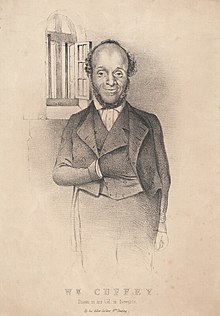
Black History Month: still no memorial for black Chartist leader William Cuffay
Those who used direct action to remove the statue of the slave trader Edward Colston earlier in the year were criticised, not least by Labour leader Keir Starmer, for failing to follow the correct democratic process for doing so.
Starmer was in favour of the statue being put in a museum and felt it should have happened a while ago, but not by the method by which it will now get there.
The point was of course that local campaigners had been trying for some years to get the Colston statue taken down and had met resistance and delay at every turn.
There is the view point, usually found on the political right, that Colston is part of British history- which is certainly correct- and so the statue should have remained but with a new plaque to reflect is activities as a slaver.
That had been tried too, at some length, and ultimately got nowhere.
With Black History Month in progress its worth recalling that there is still no memorial to the black leader of London Chartism William Cuffay either where he lived most of his life in central London or in the Medway Towns where he grew up.
Until quite recently, and this reflects how partial the history written of the British working class, even by those who were on its side, has been, he was an obscure figure.
I checked on a book about English radicalism in the first half of the nineteenth century by respected historians Edward Royle and James Walvin published almost 40 years ago. It has a chapter on the Chartist movement including 1848 but has not one mention of Cuffay.
That is not a reflection on the historians as much as the reality that it took Peter Fryer’s Staying Power, to give William Cuffay his rightful place in history.
The reality is that he was referred to by the Times in 1848 in the terms of ‘the black man and his party’. That was because he was the London organiser of Chartism in that year of revolutions and a key figure behind the great Chartist demonstration on Kennington Common on April 10th 1848.
Cuffay was to the left of the national Chartist leadership, arguably someone with revolutionary politics. He was also a central figure in a key part of the fight for what is now known as Parliamentary democracy.
Yet just as all official efforts to get the Colston statue taken down failed so all attempts to get any kind of memorial to Cuffay- who died 150 years ago this month- have also so far got nowhere.
There was a long running campaign to get a plaque put up on a premises in central London near where Cuffay had lived in the Seven Dials area. This has got nowhere because the private owner refused permission and ultimately nothing more has been done.
Medway looks a little bit more promising. I was one of the speakers at a well-attended public meeting organised by Medway Trades Council in July on Cuffay where plans to re-name an area to mark Cuffay’s origins in the area, were discussed.
There is a lot of local campaigning effort behind it so hopefully, unlike in London, something may actually happen.
It is a reminder of one of the key lessons of the Black Lives Matter movement. Certainly official channels should not be ignored. However changing the attitudes and the memorials of centuries of racism and imperial endeavours requires more than polite requests. Campaigns and protests on the ground are central, as William Cuffay himself well knew.


Leave a Reply