
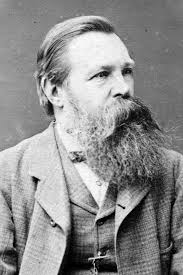
Engels at 200: beard wearer, Pilsner drinker, activist, theoretician, revolutionary
28th November marks the 200th anniversary of the birth of Friedrich Engels and it is being widely marked.
Engels wrote a landmark volume on the working class in Manchester 1844, much admired by Marx, and was an active participant in revolutionary events in Bavaria and Prussia in 1848/9. He carried the nickname ‘The General’ for his military knowledge and writing. He was of course for some years a Manchester businessman in the family business but throughout an active collaborator with Marx. After Marx’s death in 1883 Engels extended the research and impact of his friends work as well as producing some work of his own.
Some of this has been controversial amongst those who stand in the Marxist tradition but in a short appreciation the key thing to underline is Engels centrality to that tradition.
The fact that he both understood and was partly responsible for Marx’s perspectives is well summed up in the extract below:
Marx and I are ourselves partly to blame for the fact that the younger people sometimes lay more stress on the economic side than is due to it. We had to emphasise the main principle vis-à-vis our adversaries, who denied it, and we had not always the time, the place or the opportunity to give their due to the other elements involved in the interaction. But when it came to presenting a section of history, that is, to making a practical application, it was a different matter and there no error was permissible. Unfortunately, however, it happens only too often that people think they have fully understood a new theory and can apply it without more ado from the moment they have assimilated its main principles, and even those not always correctly. And I cannot exempt many of the more recent “Marxists” from this reproach, for the most amazing rubbish has been produced in this quarter, too. . . .
https://www.marxists.org/archive/marx/works/1890/letters/90_09_21.htm
As perhaps might be expected there are those who seek to draw attention away from the continued importance of such a perspective. The former Labour MP Tristram Hunt has written a partial but entertaining biography of Engels.
Writing in the Observer in November he did emphasise the political importance of Engels writings but underlined that above all Engels should be seen as a bon viveur. A lover of beer, wine and good food. Indeed Engels was all of that (as was Marx) though sadly his recipe for lobster salad has not survived.
While that was true Engels was also a serious revolutionary. It’s not his taste in drink and food that matters in 2020 but his ideas and his politics.
Engels was a figure of profound historical and philosophical significance. Yet what I discovered, as his biographer, was that his vision of socialism could also be richly uplifting: the grisly, corrupt, anti-intellectual egalitarian Marxism of the 20th century would have horrified him. “The concept of a socialist society as a realm of equality is a one-sided French concept,” he said. Instead, Engels believed in cascading the pleasures of life – food, sex, drink, culture, travel, even fox-hunting – across all classes. Socialism should not be a never-ending Labour party meeting, but a life of enjoyment. The real challenge of living in Manchester was that he could find no “single opportunity to make use of my acknowledged gift for mixing a lobster salad”.
Tristram Hunt 8th Nov 2020
This post can be found at an excellent Engels200 site:


Engels most popular work ‘ the condition of the w/class’ was not only written in a Manchester pub but the organisation of his research came as a result of visiting pubs. Engels & Lizzie & Mary Burns almost daily visited pubs not only to drink but to pool knowledge, share experience with the Chartists, early T/Unionists, Owenites, for eg, Engels met up with Ernest Jones & Harney, two outstanding Chartist leaders in the Abercrombie pub. The first ever demo Marx attended in this country, June 1855, was a protest against legislation limiting Sunday opening. The Two branches of the International in Manchester met in pubs.
The writings of Engels.
Engels made good use of the material he gathered &his experiences in Manc.He wrote for the Socialist papers, both in Britain & on the continent. He wrote for Robert Owen ‘The New Moral World’& for the Chartist paper, The Morning Star’& Democratic Review. His articles dealt with current affairs in England, the 10hr Bill, he also wrote about Socialism. The great majority of articles written for the New York Times between 1851 & 1862, or likewise those for the New York Tribune of approx that date, were written by Engels, though the appeared under Marx name. ( the reason for this is simple enough to understand as Marx received payment for this material) Or again, that famous series the ‘Eastern Question’ ( now a pamphet) appeared under Marx name but the whole series was written by Engels.
16/3/1853 Marx letter to Engels
‘ You must once again write this. The Turkish question is Spanish to me,hence I cannot give any stand point on the subject’.
The Writings of Engels are indispensable for the study of Marxism. Apart from showing Engels personal genius, his writings derive added importance from the fact that even when not produced jointly with Marx ( Communist Manifesto) they were, (until Marx death 17/3/1883) produced in collaboration with Marx. The whole plan was discussed by them before any of the works of either was written & in each case submitted for the critical revision of the other. For the purposes of Marxism, therefore, the works of Engels are largely the works of Marx, & visa versa.
Omitting an immense mass of journalistic work & correspondence & confining ourselves only to his works which have appeared in book form,( again omitting the various prefaces he wrote to every work by Marx reprinted during his lifetime) the list of Engels writings runs as follows:
The Condition of the Working Class – 1844-5
The Holy Family ( with Marx) 1844-45
German Ideology ( with Marx) 1845-1846
The Communist Manifesto ( with Marx) 1847
The Peasant war in Germany 1850
Revolution & Counter Revolution in Germany 1848 ( originally published under Marx name) 1851
The Poland the Rhine 1850
Savoy, Nice & the Rhine 1859
The Prussian Military Question & the German Labour Movement 1865
The Housing Question 1872
Anti Duhring 1877-78
Socialism, Utopian & Scientific 1880
The Labour Movement in England 1881
‘ The Mark’ given as a appendix in Socialism 1883
Origin of the Family 1884
Editing Marx Capital vol 2 1885
Editing Marx Capital vol 3 1894
The Dialectics of Nature 1885-1893
Ludwig Feuerbach 1888.
Amongst Engels papers after his death was found two parts of a social history of Ireland. Also he had intended to write a supplement to Capital Vol 3 ( ‘ the Stock Exchange’) His published correspondence with Marx runs at approx 1500 letters, but there still is quite a large number of letters unpublished as yet.
880