
Christmas Day riots
As is (hopefully) fairly well known Parliament attempted to ban Christmas, a law of June 10th 1647 forbade its celebration. This was not entirely successful but there were reasons. Christmas was associated with Catholicism, and in effect the ‘old’ ruling orders, while the Parliamentary majority now represented the Puritan ascendancy that disliked the traditions and ideas of the Catholic church.
The Puritans were also concerned, at an official level and certainly amongst local ‘activists’ that Christmas was a time of dissolute behaviour which they felt was ungodly.
Parliament was certainly not totally successful in banning Christmas activities, partly because the less well off in society liked to mark the occasion, if and where they could, their lives being quite tough enough at other times, and also because celebration was associated with the Royalist cause and in the 1650s a symbol of attempts to overthrow the Commonwealth.
Certainly at Christmas 1647 a number of Church Ministers were jailed for attempting to mark the occasion.
Down below Christmas 1647 saw a number of riots in defence of celebrating the day.
Mark Stoyle has written in History Today about some of those that were recorded;
On 25 December 1647, there was further trouble at Bury, while pro-Christmas riots also took place at Norwich and Ipswich. During the course of the Ipswich riot, a protestor named ‘Christmas’ was reported to have been slain – a fatality which could be regarded as richly symbolic, of course, of the way that parliament had ‘killed’ Christmas itself.
In London, a crowd of apprentices assembled at Cornhill on Christmas Day, and there “in despite of authority, they set up Holly and Ivy” on the pinnacles of the public water conduit. When the lord mayor despatched some officers “to pull down these gawds,” the apprentices resisted them, forcing the mayor to rush to the scene with a party of soldiers and to break up the demonstration by force.
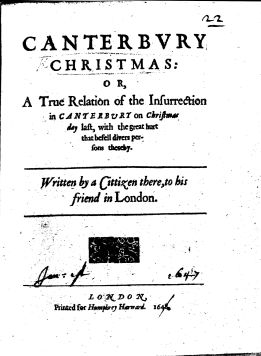
The worst disturbances of all took place at Canterbury, where a crowd of protestors first smashed up the shops which had been opened on Christmas Day and then went on to seize control of the entire city.
There is some interesting new-ish research on this here:
http://roy25booth.blogspot.co.uk/2009/12/riotous-christmas-at-canterbury-1647.html
As with the Gordon Riots in London in the 1780s we need to be careful in applying modern labels of ‘reactionary’ or ‘progressive’ to such events. They may well have been Royalist influenced, and hence in the context of the 1640s counter-revolutionary, but once they were in progress they became a force that could challenge the existing order, whoever was in charge of it.


Leave a Reply