
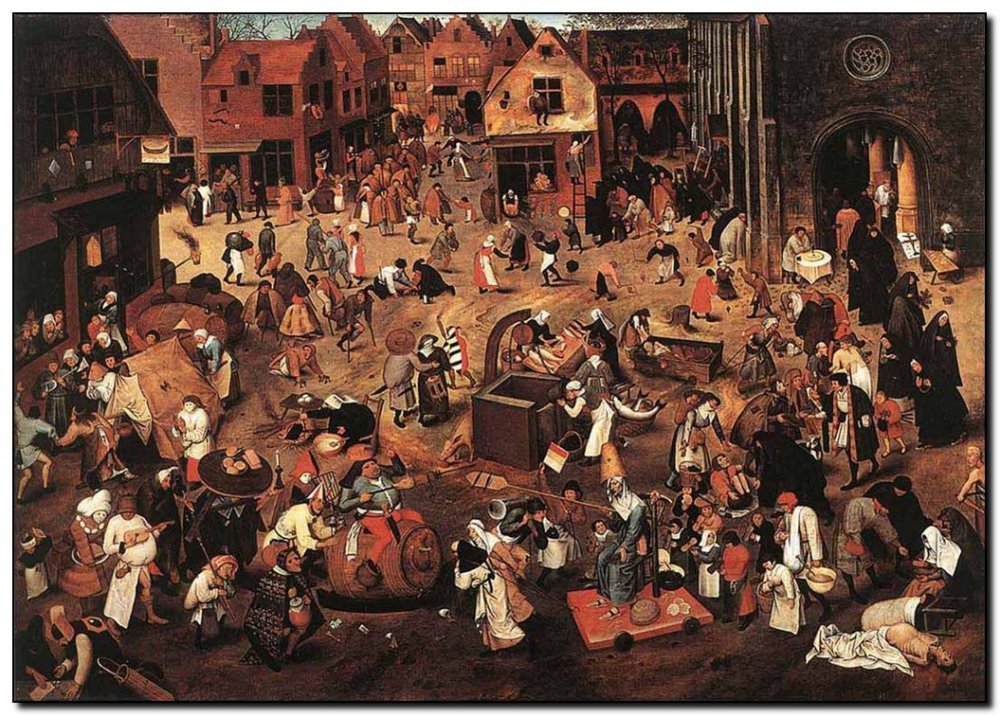
New Year’s Day: The Feast of Fools & Turning the World Upside Down
Each of the Twelve Days of Christmas had some festivity associated with it but the one that gained the widest purchase beyond Twelfth Night itself was the Feast of Fools, which took place around January 1st.
An account of the Feast of Fools suggests that it was very much a World Turned Upside Down occasion, Carnivalesque in its disrupting of the established order and hence not approved of by senior clergy:
Participants in the Feast of Fools reversed all customary rules of proper church behaviour. Instead of presiding over religious services with dignity, seriousness, and reverence, they brought the coarse, lusty, irreverent behaviour of the carnival to church. After their wild mass, they often roamed the streets in an equally wild, mock religious procession. In some places merrymakers chose a bishop or archbishop of fools to preside over the celebration. As insignia of his newfound rank he wore a bishop’s miter and carried a bishop’s staff. Clerical participants in the follies often dressed in street clothing, including women’s clothing, masks, garlands of greenery, or even in fools’costumes.
The wider issue is what the impact of this custom was, banned by some religious authorities in the Middle Ages because it was so disruptive.
The Feast of Fools is a central element in Shakespeare’s Twelfth Night but here it cast very much as a ‘letting off of steam’ mocking authority so that authority can return secure for another year. By contrast Bakhtin, particularly in his work on Rabelais sees the Feast as underwriting the Carnivalesque, a subversion of authority that is not so easy to put back in the box.
The Feast of Fools, a festival of the oppressed to start 2021?


Leave a Reply