
A World We Have Lost. Tony Benn on Winston Churchill’s funeral 30th January 1965
Winston Churchill died aged 90, fifty years ago, on 24th January 1965. He had a State funeral on 30th January 1965.
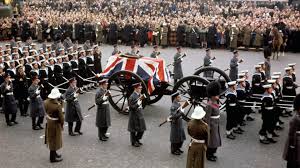
I Watched the re-run of the funeral on BBC Parliament on the 50th anniversary in 2015 (in black and white, but then it was a more black and white world then) with commentary by Richard Dimbleby. I could just recall watching it at the time (I was 8 years old) though my parents were no fans of Churchill. It was a conservative world based on rank and privilege. It was also a very white and a very male world. Britain has changed but one wonders, at root, by quite how much. Certainly one suspects that most of the present Cabinet hanker for an imperial past.
Many on the left remember Churchill has a class warrior, at the Siege of Sidney St in 1911, sending troops to Tonypandy a year earlier, but later during World War Two as the leader of a National Government that charted a course that saw Allied forces to defeat the Nazis. Also however as someone who also, for example, didn’t intervene in the Bengal Famine of 1943 but did intervene to prevent the left from taking power in Athens in 1944/5. At the war’s conclusion in May 1945 he was decisively rejected by electors in favour Labour and Clem Attlee.
He is still a figure of veneration for the right- Boris Johnson produced a badly researched biography in 2014.
It is interesting however to reflect how he was remembered at the time of his death in 1965 by Tony Benn.
Benn records in his Diary that Churchill had been in touch with the family in the 1940s and had been a supporter of his campaign to renounce his hereditary peerage and become an MP again in 1963.
Perhaps it is not surprising that on the day of Churchill’s death Benn wrote in his diary that he was ‘one of the greatest Englishmen of our time’. Partly Benn had not yet fully made the move to the left that he took in the 1970s. Indeed in 1965 he was Postmaster General in Harold Wilson’s Labour Government. Partly no doubt his personal dealings with the Tory leader coloured his view.
Benn records that politics would be put into ‘cold storage’ for a week and it is probably the case that Churchill was the last political leader- partly because of his wartime role- where there was an element of agreement on the significance of his life and death, however viewed. Certainly there were none of the protests and dissent seen when Mrs Thatcher died.
The Postmaster General’s first move was to approach Wilson with a plan to issue a commemorative stamp featuring the picture of the Queen and Churchill. It related to Benn’s campaign to remove the monarch’s image from stamps altogether and it is clear that even with a figure like Churchill, Wilson regarded the idea as doubtful.
Later in that final week of January fifty years ago Benn took his family to see Churchill lying in state at Westminster Hall. He notes that young Joshua Benn thought he was going to a Lyons Steak house and was perplexed as to who Churchill was.
Benn returned to this theme on the day of the funeral at St Paul’s Cathedral which he attended with Caroline Benn. He notes in his diary that ‘there were thousands of troops standing there and the crowds on each side were extremely heavy’.
His regard for Churchill notwithstanding Benn noted that the funeral made him feel uneasy. It was attended by an array of world leaders but Benn thought it the ‘last great Victorian festival’ and left as soon as decently possible.
Some might argue that over 50 years on Britain is now a long way off the imperial era represented by Churchill, yet the State pomp and circumstance seen at his funeral is still very much part of the way the British Establishment goes on. The same monarch remains on the throne and politicians with very much the same kind of class and educational pedigree of Churchill himself sit in the Cabinet.
As the Sex Pistols noted in 1977 ‘there is no future in England’s dreaming…’


Leave a Reply