
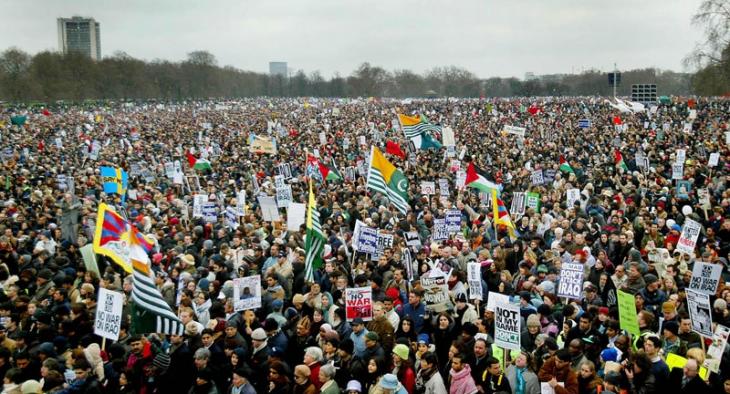
15th February 2003: The biggest protest in UK history 23 years on
It is twenty three years this week since the biggest march in British history, against war in Iraq, on Saturday 15th February 2003.
Below is a slightly edited version of what I wrote on the 10th anniversary.
The march is not yet history and is some way from being so. The political arguments about war, imperialism, defence and intervention continue and many of the leading players in 2003 remain active today, holding, as they did then, a wide range of views on the world, but still including opposition to illegal wars.
It does however continue to be important to keep remembering that the event took place and left a mark on a generation. Perhaps not surprisingly the blockbuster film has yet to appear and perhaps never will. But what happened and what it achieved should continue to be something that is discussed and debated.
__________________________________________________________________________________
10 Years After: The Historical lesson of 15th February 2003- Keep Marching On
Many readers of this will have been on the central London demonstration called by the Stop the War Coalition on Saturday 15th February 2003 as I was myself.
It was the biggest demonstration in British history and remains so.
The British Government still has imperial ambitions. But whereas before that cold Saturday ten years ago it would have been a minority of left and peace voices that spoke out, today it is legitimate for a broad range of opinion to question why the country is intervening in wars elsewhere and what purpose it serves.
The media are unlikely to be devoting special supplements and programmes to the anniversary although in truth that is what it deserves.
Making sure the demonstration is remembered and underlining the historical point that popular mobilisations make a difference is important.
While there were many young people on the march, the fact remains that there are people in their twenties and thirties today who are too young to have either been on the march or to remember it. If in today’s environment it was said,’ we can mobilise well over a million in people in central London for an important issue’, eyebrows might well be raised. Yet just 10 years ago we did exactly that.
So making sure that the event is remembered and remains in the popular memory is an important task not just for historians but for the left generally.
For those who were there, and it was estimated that someone from most households across the UK was, the question ten years on remains one of what impact was made, and whether marching changes anything.
Here history can provide some pointers.
As the historical sociologist Charles Tilly argued in his book Repertoires of Contention- looking at Britain in the late eighteenth and early nineteenth centuries- people fighting injustice can follow a range of strategies. These can vary from petitions through strikes to armed revolts and from riots to large indoor meetings that agree to lobby Parliament.
It depends what is thought to be effective at the time and what mobilises numbers for the maximum impact. In recent times a march with a large and broad turn-out, although far from the only strategy, has often made a significant and sometimes lasting political point.
There is another angle made by the late Peter Sedgwick in his introduction, Farewell, Grosvenor Square to David Widgery’s 1976 volume about the left in the 1960s.
Sedgwick argues that until the rise of CND in the late 1950s the idea of going on a demonstration to make a political point seemed an odd one for many. If you wanted change you wrote to your MP and voted for a Government from time to time.
The minority who did march were watched by many more from the nearest pavement.
From the 1960s all that changed. As Sedgwick noted when delivering leaflets door to door for a protest the reaction was no longer puzzlement from the householder but ‘thanks luv see you at t’demo then’.
Even if a march does not have the precise consequences that were desired it often does beg significant political questions and may do so long after the last marcher has returned home.
That’s why it is important to keep remembering that cold Saturday of 15th February 2003 and to keep in mind that it can happen again.
But while we are remembering 15th February it is important not to forget some other points.
The march did not stop the drive to war with Iraq as the usual suspects have been busy reminding us. But the war itself did not come until a month later on March 19/20th 2003. At that point the aim of anti-war activists was to take protests beyond demonstrations towards walk-outs and industrial action. Numbers did take place, but not sufficient numbers to reinforce the impact of 15th February. It suggests that in the circumstances of the time the mass march was far from being our best strategy to stop the war but in fact the best shot we could muster. Unfortunately it was not enough
Finally a literal footnote. Despite the concern of the Royal Parks and the then Culture Secretary, the late Tessa Jowell, the grass in Hyde Park survived the march and last time I checked was still thriving.

 Kmflett's Blog
Leave a comment