
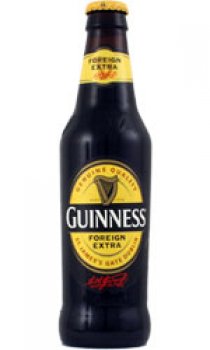
Guinness Foreign Extra Stout: an imperial beer twice over
There are of course plenty of excellent Irish craft beers around so it was not a liking for big beer (Guinness is owned by Diageo) that made me decide to drink a Foreign Extra Stout (7.5%) to mark St Patrick’s Day. It was the fascinating if perhaps disturbing (albeit well hidden) history.
It was first brewed for export to the West Indies in 1802 and later to a range of African countries. In some cases it is now brewed there with extract from Dublin so the beer originally called West Indies Porter is sometimes known as Nigerian Porter.
But why West Indies? What were the Irish doing in the Carribbean in the early nineteenth century?
The answer inevitably lies with British imperial endeavour.
Cromwell who was not keen on most of the Irish despatched some to the West Indies in the 1650s, where they became indentured servants working on plantations:
https://en.wikipedia.org/wiki/Irish_immigration_to_Montserrat
150 years on some had become wealthy and no doubt slave owners (slavery was not officially abolished until 1833 by the UK Parliament). No doubt the stout was primarily for their consumption.
The spread of the Foreign Extra Stout around the world was also of course in large part to what was once known as the British Empire.
The strength now at 7.5% appears to have been once as high as 9% but has been at is current ABV for over a century.
Reportedly 500,000 bottles were requisitioned by the Government for hospitals in World War Two.
It’s now available as befits a product of Big Beer in many large supermarkets.
It remains though an excellent beer (albeit as Roger Protz and others remind us, it would be better bottle conditioned, as it was until 1948) and imperial in more than one dimension.


It is a pleasant brew..and locally the only bottled Guinness available, sometimes the only Guinness…..