
The Chartists and the Census
I’ve filled in the 2021 Census form.
I know, particularly living in North London perhaps, that there are those who are likely to avoid doing so. This is usually because their circumstances, invariably through little or no fault of their own. People do not wish to draw the attention of the State to their presence, even if this isn’t what the ONS run survey in England and Wales is about.
I have however no reason not to fill it in and an important one for doing so. Namely that as well as providing useful data for current planning purposes (assuming any gets done) it is also over time provides historians with one indicator of what the population was doing and who it was at particular snapshots in time.
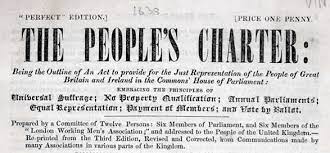
In that sense it has a role to play in democracy and it is worth remembering that the Chartists in 1838 wanted Parliamentary constituencies to be worked out on an equal basis related to census returns.
That has turned out to be a bit more complicated in practice but the historical framework remains interesting
The definite provisions fall under six heads — the famous “Six Points” of the Charter. First, every male adult is entitled to the franchise in his district after a residence of three months.[2] Second, voting is by ballot. Third, there will be three hundred constituencies divided as equally as possible on the basis of the last census, and rearranged after each census. Fourth, Parliament is to be summoned and elected annually. Fifth, there is to be no other qualification for election to Parliament beyond the approval of the electors — that is, no property qualification. Sixth, members of Parliament are to be paid for their services.
Extract from the 1838 People’s Charter


Leave a Reply