
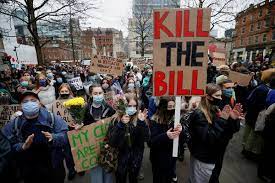
‘Kill the Bill’ protests & Bristol. Johnson sees a ‘mob’. Historically it looks like a protest crowd
Priti Patel’s new authoritarian Bill on policing and protest has sparked protests around the UK.
Those in Bristol have received much media and social media reporting and comment. Clearly people can look at these for themselves. Historically it’s difficult to see even the most combative of protesters here as anything but rather mild. The police response is probably serving most of all to remind those of a younger generation than myself that the officers are there not to facilitate but to frustrate protest, whatever they may say.
Boris Johnson has described the Bristol protesters as a ‘mob’. Looking at social media they however mostly seemed to be quite well disciplined, unlike numbers of police officers. Again you can look and take a view for yourself.
The usage is important because historically there is a world of difference between using the term ‘mob’ and describing the same gathering as a crowd.
Edmund Burke commenting on the French Revolution saw only a ‘mob’. Later historians have taken a different view. George Rude, probably the leading historian of crowds, used the term deliberately to cover a broadly progressive gathering of people. E P Thompson was slightly less sure detecting in some crowds, for example the Bristol Riot of 1831, elements of behaviour such as book burning which would have been better attributed to a reactionary mob.
The point is that while a mob is thought to behave irrationally, a crowd is usually understood to have gathered for a purpose.
In eighteenth century England what many in the ruling orders certainly regarded as mobs often came together to protest about the quality or price of bread and demand changes for example. Yet these protests were organised and far from irrational.
However the crowd takes the stage of history when mass democratic politics, trade unions and political parties with individual membership appear. We can date this in Britain to around the time of Peterloo, one reason why the authorities were so concerned about the protesters for the vote who gathered in Manchester on August 16th 1819. They sensed this was a new form of crowd protest, organised and disciplined but struggled to grasp how to relate it. On that occasion it was with violence.
Crowd protests in the twenty-first century usually rely on weight of numbers to make their point peacefully but that doesn’t mean that there is not what the American sociologist Charles Tilly called a repertoire of protest.
One thing is for certain. The ‘noises off’ of the crowd remain essential to effect real change.


Leave a Reply