
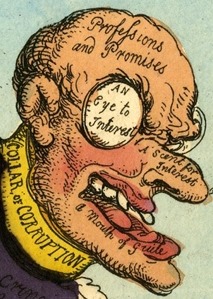
Not just what Hancock didn’t do, but he did. The continuing stench of Cobbett’s Old Corruption
Its no secret that Dominic Cummings wants Matt Hancock sacked as a Minister. Precisely why is less clear but his latest revelations, if true, reflect a dreadful absence of competence in the first weeks of the Pandemic in March 2020
https://www.bbc.co.uk/news/uk-politics-57498845
But there remains the question, which should not be forgotten of the things Hancock actually did.
In February 2021 a Court ruled that the Government and in particular Health Secretary Hancock had failed in a legal duty to be sufficiently transparent to whom they have awarded contracts related to the pandemic to.
The Government legislated to remove the usual safeguards around tendering for contracts given the COVID emergency but this did remove a requirement for accountability on what had been done
https://www.bbc.co.uk/news/uk-56125462
The BBC reported as a lead item on its news website that:
Labour claimed the government’s awarding of contracts was “plagued by a lack of transparency, cronyism and waste”.
It’s something that has an echo in British history perhaps particularly in the views of William Cobbett
EP Thompson encapsulated the Cobbettian worldview in the Making of the English Working Class. Describing Cobbett’s intervention in the 1806 election for the Westminster seat in the unreformed Parliament, he noted how Cobbett summed up the opponents of the radical candidate:
relations of placemen and pensioners’, ‘tax-gatherers, magistrates, policemen and dependent clergy’, ‘play-actors, scene-shifters, candle-snuffers, and persons following.. immoral callings’.
In his Rural Rides, Cobbett criticised ‘pensions, sinecures, tithes and the other ‘glorious institutions’ of this ‘mighty empire’. He referred to this collectively as The Thing.
That world eventually began to change as Parliamentary Democracy started itself to be renewed with the 1832 Reform Act. It might be noted however that the passage of the Act was a fine call between reform and a plebeian revolution.
Hancock’s behaviour belongs in a pre-democratic age before the 1832 Reform Act.


Leave a Reply