
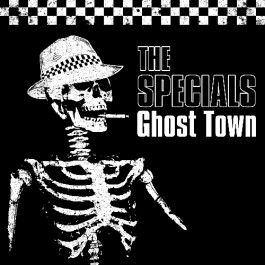
40 years of the Special’s Ghost Town. A history of the present
June 2021 marked the 40th anniversary of the release of the Specials single Ghost Town. It went on to spend three weeks at Number One in the charts in the summer of 1981.
Recorded in Leamington Spa and produced in Tottenham, the single is now part of social history capturing the disaffection and impact of the first years of the 1979 Thatcher Government.
It has been re-released to mark the anniversary but its significance goes far wider than the music charts. It speaks to an experience of particularly younger people under a Tory Government that is not so different in 2021 despite the passage of four decades.
The idea for the song, both the lyrics and the musical style came to the Specials Jerry Dammers as the band were touring the UK in 1980. They saw the first impacts of Thatcherism, with closed shops and businesses and people begging on the streets.
The following year saw the first reaction to this with riots, starting in Brixton in April 1981 and by the summer when Ghost Town was to be heard coming from car radios, a much wider area. Unemployment had risen to 2.5 million and the Metropolitan Police were engaged in the racist policing exercise branded ‘Operation Swamp’
It seemed like the music and the political reality were matching.
Dammers went on to produce the political anthem Free Nelson Mandela in 1984 before pursuing wider anti-racist music and cultural work.
40 years on the re-release of the song is a reminder of the times in 1981 but also that life under another Tory Government is not significantly different. The pandemic of the last year has had a specific impact but before that 10 years of Tory austerity had seen the pattern of joblessness, crumbling high streets and racist policing reassert itself, after the limited, pre-2008, adjustments of the New Labour years.
In short Ghost Town is a history of 2021 as much as 1981.
It goes wider than that however. An indication came from the unlikely source of the Chief Medical Officer Chris Whitty. Speaking to an NHS Confederation conference on 17th June, Whitty made a rare foray into historical contextualisation.
He argued that the areas of the country where COVID had hit hardest, were clearly defined, and invariably featured, during periods when infections rose.
He specifically mentioned Bradford, Leicester, parts of London and the north west, that have been hard hit over the last 15 months but also areas where deprivation is most noteworthy.
He went on to argue that a map of Covid’s biggest impact now and a map of child deaths in 1850 would look remarkably similar.
His view was that there were areas where deprivation had been prolonged and deeply entrenched not just over 40 years but over 170 years. It was a devastating indictment of the history of market capitalism although not one, of course, that attracted the attention of much of the media.
It is unlikely that Chris Whitty will be singing a rendition of Ghost Town at his next Downing St press conference but the lyrics of 1981 still speak to our times:
Cant go on no more,
The people getting angry,
This town is coming like a ghost town
That of course is specifically and particularly true for many in the music and wider culture fields, many of whom have not been able to work due to restrictions since March 2020 and who the Government has mostly overlooked when it comes to financial assistance. Time to be angry indeed.


Leave a Reply