
Pandemics. Lessons from the Nineteenth Century on people & profit
Boris Johnson has announced an end to most restrictions related to COVID-19 in England from July 19th. Infections are currently rising but there is pressure from business to open up and pressure too from a considerable range of people who have been badly hit over the last 15 months or so by loss of work and contact. The conundrum of profit or people is ultimately one that can be found in the nineteenth century as well as the twenty-first.
In pre-modern history plagues could wipe out significant sections of the population and create conditions for what is now known as ‘regime change’. The Black Death in 1348-9 is thought to have killed around 40% of the population in some cases for example, sparking social upheaval.
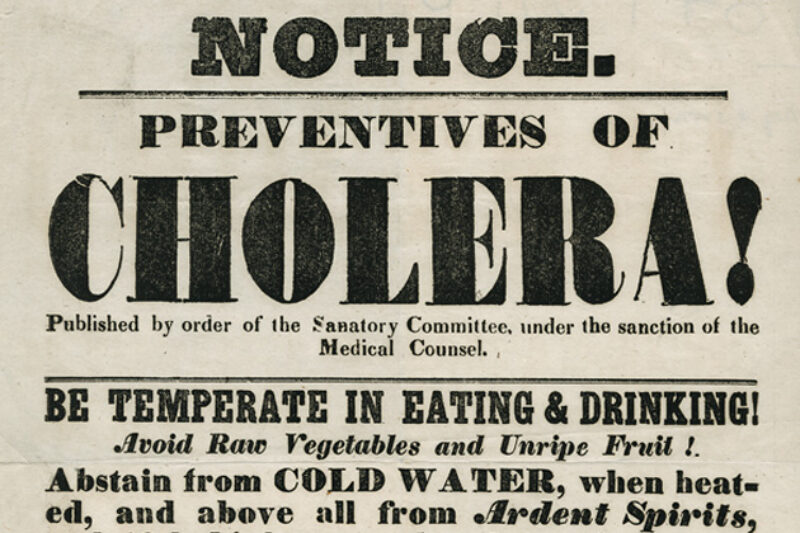
From the nineteenth century on this has been less the case. Societies began to be able to control and disease better. While successive epidemics of diseases like Cholera and TB swept the world in the 1800s-and in fact still do in some parts the globe- and large numbers died as a result, the proportion of now much larger populations impacted was more limited. Even the most severe cholera epidemics killed at local peaks 15-20% of people.
The relationship between epidemics, their impact on society and protest and change has been more complex in the last 200 years but a relationship there still definitely is.
Haiti Dictator ‘Papa Doc’ Duvalier was ousted in 1986 following popular unrest. This related to a rise in AIDS case in the country which put off visitors from the US, sensibly or not, and caused a collapse in the tourist trade, a central feature of the Haiti economy. The resulting job losses led to revolt.
This pattern can be broadly seen in nineteenth century cholera epidemics.
The two largest took place between 1830-32 and 1848-49. These were times of social change and revolution around the world. Wars and revolutions, also provoke population movements and refugees. This was a way epidemics spread in the nineteenth century and remains so in 2021.
The link between epidemics and revolution was a strong one at least in the mind of reactionaries. In France in 1849 some called cholera a ‘revolutionary infection’ seeing its spread as being caused by the ‘dangerous classes’ every bit as much as revolt could be.
More often though it was not revolution but riot and protest around epidemics and their impact that was seen. With job losses, poverty and lack of adequate food the issue was who to focus protest on. Governments were an obvious and relevant area with claims that they did little because they were not troubled by deaths of poor people. Sometimes it was medical authorities themselves who were faced with protests that they had not done enough. Much of this may seem rather familiar in 2021 as well.
Of relevance to 2021 is that while many Governments used similar techniques of control when epidemics first broke out-isolation, quarantine, control of movement, these didn’t ultimately work. That was because not only the cause of epidemics such as cholera was poorly understood but also because there was no effective medical remedy.
In 2021 we are in a different place. COVID-19 while a new virus is at least partly understood. There are very effective vaccines although progress in vaccinating people around the world varies hugely
When epidemics reasserted themselves in the nineteenth century as they invariably did, Government reaction was mixed.
Some, where they had the ability to do so- such as Prussia- implemented police measures which remained mostly in force long after the epidemic had retreated. Others did little. In Hamburg for example nothing was done because of the impact quarantine had on trade but also because police measures posed a threat to public order. Clearly deaths took place as a result.
Perhaps it might be reflected that the best way out of this conundrum is to find an effective vaccine if not to prevent an epidemic to control and restrict its impact. Fortunately in 2021 society is much better placed to do that than it was 150 years ago.
The conclusion we might draw is that while modern science and vaccines have the potential to change matters hugely the social pressures and class forces at work remain very familiar from the earlier periods of market capitalism
The key text on the subject is Richard J Evans, Epidemics and Revolutions, Past and Present 120, August 1988


Leave a Reply