
Workers Sport
The 2024 Olympics has, as often, drawn criticism on the basis of its promotion of nationalism in sport tempered with admiration for the achievement of individual athletes who are not tied up with such agendas.
But what of the history of working class organisations and sport? It is one that is largely forgotten.
Perhaps the only moment of dissent now recalled is the powerful black power salutes at the 1968 Olympics, a symbol that echoed around the world.
But the history of working class sport goes much deeper and broader. It was not just a question of protest at officially organised events but a whole alternative sporting structure.
In 1914 as the First World War broke out there were 350,000 workers in sports organisations in Germany. By 1928 this had risen to two million. There were 60 sports papers with a readership of 800,000. These structures were organised by the socialist party the SPD. However by 1931 the German Communist Party KPD also had a separate sports organisation of 100,000 members.
The extent of these organisations was considerable. For example the German workers cycling association had a co-operative cycle production factory. In Austria in 1930 the workers swimming association gave 100,000 free swimming lessons
By contrast in Britain there was more space to operate inside the system. The origins of team sports often lay with works or factory side sponsored by employers. There was no systematic attempt to exclude socialists or trade unionists.
The highest profile aspect of workers sport were the alternative workers Olympics.
The Barcelona workers Olympics of 1936 which had to be cancelled at the last moment as Franco’s forces advanced has had the largest historical profile.
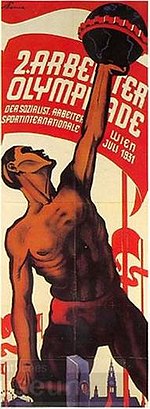
The first, unofficial workers Olympic was in Prague in 1921 but the first official event was in Germany in 1925. 150,000 were said to have attended. Vienna followed in 1931with 100,000 competing from 26 countries and Antwerp replaced the ill-fated Barcelona games in 1937.
All these events were organised by the social democratic Socialist Workers Sports International which by 1931 had 1,300,000 members.
The Communist influenced Red Sports International held festivals in Moscow in 1928 and Berlin 1931. After that as fascism became a serious threat and political positions changed the impetus for separate events was less.
It is the story of the failed Barcelona Olympics of 1936 that is perhaps best known
They were termed the People’s Olympic Games and scheduled for 19-26th July 1936 in opposition to the Nazi dominated Olympics in Berlin. The idea was to hold a ‘popular sports festival which does not hope for record feats but intends to preserve the true Olympic spirit of peace and cooperation between nations’
Despite the most difficult of circumstances 10,000 athletes from 20 countries including the UK, Canada, France and Holland arrived.
Shamefully Avery Brundage declared them the ‘communist games’.
The British Workers Sports Association sent 40 athletes including some quite well known ones such as the Welsh 100 yards champion EG Cupid and the tennis player Bernard Bamber as well as the chess player AR Northcott from Acton Labour Sports Section. There was a delay in getting agreement from the UK Amateur Athletics Association but it was agreed the games were an officially organised event, permits were issued and the British team left Victoria station on 17th July 1936.
Their arrival coincided with the final and successful assault by Franco’s forces on the Republican Government and the British team were evacuated by the Royal Navy.
Some who had gone to Barcelona stayed on to become part of the International Brigades


Leave a Reply