
Electing a Labour leader: a matter of historical perspective
I don’t always agree with what the political correspondent Stephen Bush of the New Statesman writes but when it comes to media reports on changes Keir Starmer’s plans to how Labour leaders are elected he is right.
Every available position has been held by the key sections of the Labour Party at some point in the last 40 years or so.
Originally the Leader of the Parliamentary Labour Party was elected only by MPs. One might speculate that the changes in how people saw the world after 1968 led to a mood reflected in Labour but also elsewhere that this was not democratic enough.
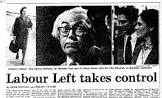
Labour held a Special Conference at Wembley on 24th January 1981 to look at moving away from the MP only method of electing the Labour leader.
Tony Benn and the Campaign for Labour Party Democracy which had pressed for change wanted an Electoral College. Benn recorded in his Diary:
Eric Heffer moved the principle of the Electoral College and Frank Chapple of the EEPTU then proposed the ballot of individual members. Moss Evans (TGWU now Unite)spoke for the College at conference. David Owen said he stood by the principle of one member one vote..
In the end an USDAW motion proposing an electoral college of 40% trade unions and 30% for MPs, 30% for CLPs was passed by 5 million votes to 1.8 million.
The right supported OMOV because they wanted to split from the unions. So committed were David Owen and others to Labour democracy that shortly afterwards they walked out to form the SDP.
The Electoral College was seen then as an advance by the left, while both Neil Kinnock and John Smith backed OMOV.
Labour moved to OMOV under Ed Miliband in 2014. By this point the left saw the trade union leaders(not union members) as a conservative layer who blocked any chance of an effective radical Labour leadership
Meanwhile the Tories had moved to OMOV in 1998 and William Hague was the first leader elected under the system in 2001.
Reports suggest that Starmer wants to move back to an Electoral College. I suspect this is not because he has been reading the collected works of Tony Benn. He sees a union vote as a block to a more radical membership. It might be reflected though that it was precisely this membership that gave him a resounding victory as leader just last year. Meanwhile the current leaders of the largest affiliated unions, certainly Unite and perhaps the GMB, may be less than thrilled with the idea that they again will be charged with a significant role in determining the Labour leader. They have other priorities in 2021 often focused on practical policies to defend members.


Leave a Reply