
Owen Paterson, Boris Johnson & William Cobbett’s Old Corruption
There was rightly a furore after Tory MPs (for the most part) voted not to carry through the suspension of Tory MP Owen Paterson from Parliament (Paterson himself voted against his suspension) for share dealings which Keir Starmer correctly labelled ‘corruption.
MPs have standards of behaviour and an independent committee found that Patterson had broken them. Johnson’s response was not to back the committee but to have a look and see if rules could be changed to allow corrupt dealings.
After anger at this attempt to avoid democratic scrutiny and accountability Owen Paterson has resigned as an MP. The media have labelled it a U-Turn by Johnson, but behind that lies a lot of present and past history.
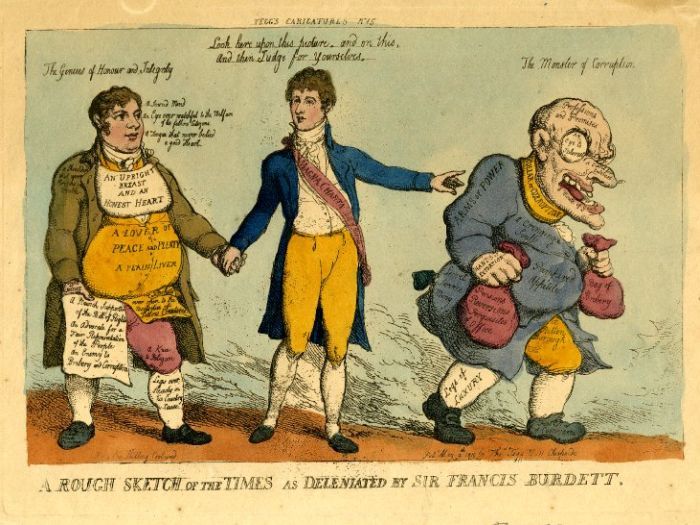
During the 24-hour period when Johnson supported Paterson and then he didn’t there was much media and social media discussion of sleaze and corruption and even an occasional reference to Old Corruption. While recent Parliamentary times have seen a good deal of dodgy practices from MPs expenses to David Cameron’s business interests there was a time when such things were a fully institutionalised part of Westminster politics
The whole Paterson episode has echoes in the views expressed by William Cobbett on politics and Parliament in the pre-reformed Parliament of the 1810s and 1820s where many MPs did much as they liked unencumbered by any democratic accountability.
It was in this period for example that a Tory Government not only evaded any blame for the Peterloo Massacre of 1819 but carried through a series of repressive measures, the Six Acts, to crack down on democratic protest even further. One suspects this is one of the periods of British history that Boris Johnson keeps firmly in mind.
EP Thompson encapsulated the Cobbettian worldview in the Making of the English Working Class. Describing Cobbett’s intervention in the 1806 election for the Westminster seat in the unreformed Parliament, he noted how Cobbett summed up the opponents of the radical candidate:
relations of placemen and pensioners’, ‘tax-gatherers, magistrates, policemen and dependent clergy’, ‘play-actors, scene-shifters, candle-snuffers, and persons following..immoral callings’.
In his Rural Rides, Cobbett criticised ‘pensions, sinecures, tithes and the other ‘glorious institutions’ of this ‘mighty empire’. He referred to this collectively as The Thing.
In the Peculiarities of the English (1965), Thompson explained why the practice of Old Corruption caused such resentment in the late 18th century: “It alienated the sisters and the cousins and the aunts of those who had not obtained preferment, the officers who had not been promoted, the clergy who had not found patrons, the contractors who had not obtained orders, the talented who had been passed over, the wives who had been snubbed.”
It would appear that the Tory MPs who Johnson arm twisted into saving the Parliamentary career of his mate Owen Paterson, only for him to be ditched the next day, have a rather similar view in 2021.
That world eventually began to change in Cobbett’s time as Parliamentary Democracy started itself to be renewed with the 1832 Reform Act. It might be noted however that the passage of the Act was a fine call between reform and a plebeian revolution.
Its good for Parliamentary democracy that Paterson eventually resigned but the wider point is that Johnson’s Government is deeply mired in the practices of Cobbettian Old Corruption. Sinecures and favours for mates are rampant, democratic practice is not.
The 1832 Reform Act averted a revolution in Britain. If action isn’t taken on Old Corruption 2021 there could be real trouble ahead for the ruling order.
This post first appeared in the Morning Star


Leave a Reply