
London Socialist Historians Group
Media Release 15th November
Contact Dr Keith Flett 07803 167266
Historians call on Boris Johnson to make sure histories of World War Two include the work of anti-Nazi German refugees in Britain.
The London Socialist Historians Group that organises the socialist history seminar at the Institute of Historical Research, University of London, has called on Boris Johnson to make sure that the details of anti-Nazi refugees who fled to Britain and continued to oppose and undermine the fascist war effort, are included in British histories of the war and post-war period.
The refugees were socialists, communists and Trotskyists who sometimes worked with the British Government and sometimes acted independently. Once the post-1945 Cold War started their heroic activities were left out of histories of the period and are only slowly being recovered by researchers.
LSHG Convenor Dr Keith Flett said, one of the most persistent right-wing myths about World War Two was that all Germans were Nazis. It has become a persistent caricature and often a joke in popular culture. The reality was very different and its time British histories reflected that.
On Monday 15th November Merilyn Moos spoke to the socialist history seminar on ‘German Socialists in Britain and their Shifting Alliances 1933-1945’
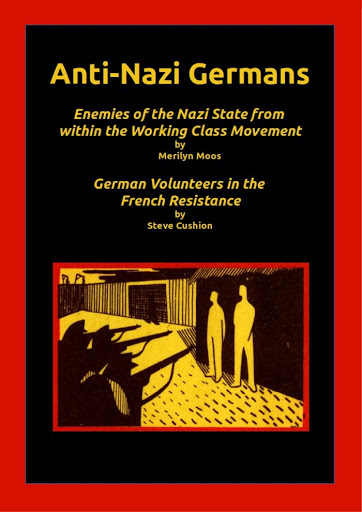
Merilyn Moos introduced her 3 e-books celebrating the lives and struggles of left-wing Germans who opposed the Nazis from exile. These may be freely downloaded at this link:
http://londonsocialisthistorians.blogspot.com/2021/10/upcoming-lshg-seminars.html
Anti-Nazi Exiles German Socialists in Britain and their Shifting Alliances 1933-1945
by Merilyn Moos
Hans Jahn Biography of an Anti-Nazi Trade Unionist
by Merilyn Moos
German Anti-Nazis and the British Empire The Special Operations Executive, Deserters from the German Army and Partisan Movements in Occupied Europe
by Merilyn Moos
The refugees Merilyn discusses almost all fled Germany as political activists, most from a working class background. They risked their lives again and again in Germany, often escaped arrest and probable death without knowing where they would end up.
Most survived. But, once in Britain, organising an anti-Nazi struggle became very difficult and there was much disagreement as to the best means. Merilyn examines the details of a few of these refugees. One example is Hans Jahn, President of the German Railway Union. Faced with the Nazis’ attempt to break working class organisations, he tried to organise anti-Nazi resistance amongst railway workers, even when, later, he was exiled here. He was to say that “one of the greatest tragedies is that German unions did not fight to prevent Hitler taking power in 1933”.
More ferociously anti-Nazi than many at the time in the UK, some anti-Nazi German exiles risked their lives all over again in an often uneasy alliance with sections of the British military. Some worked with SOE. A small group, almost all of whom had fought in Spain, fled to France and then were sent by the French Government to camps in Algeria. They also ‘volunteered’ to fight with the British. Thousands of Germans were conscripted into the 999 ‘Death battalions’, a sub-section of the Wehrmacht, made up largely of political prisoners. Many of them either deserted to the partisans in Greece or clandestinely supported them. Upon the partisans’ defeat, a few of the German deserters escaped to Albania and supported their partisans. The tensions within British policy between being anti-fascist and pro-imperialist, are sharply exposed during the Greek civil war when the German deserters who first were fighting with the partisans alongside the British against the Nazi forces, then fought with the partisans against the British.
It is a good time for such stories of courage and resistance to be heard.


Leave a Reply