
The Rittenhouse verdict underlines that the Rule of Law doesn’t exist in America
The left generally are not enthusiasts for the ‘rule of law’ and particularly employment law. Those who fulminate about the importance of judges and the law are often seen as being Tories intent in preserving the practices of an unjust society. Often they are.
The acquittal of Rittenhouse in the US underlines however what the rule of law in a class society is about. Rittenhouse was part of a white armed militia that sought to provoke anti-racist protesters. He then murdered two of the protesters and seriously injured a third.
He claimed this was self defence and he was acquitted on that basis. Right-wing US politicians cheered the verdict, those to the left and anti-racists didn’t. President Biden noted that he wasn’t happy with the verdict but it was a jury decision.
Indeed it was a jury decision but it might be argued that they had been misdirected by a judge seen as sympathetic to racism.
This was not the rule of law. Rittenhouse murdered two people and was in the area to cause trouble. That is not self-defence. The verdict reflects a view that its ok for white people to murder black people but not vice-versa, as many have pointed out.
Of all the post-1945 figures to have considered the Rule of Law the one who arguably wrote most powerfully on it was E.P Thompson.
He devoted a concluding section of his book Whigs and Hunters to the matter. In the book Thompson looks at the eighteenth century Black Acts which listed a growing number of often petty offences for which offenders could be hanged. It was the period of the ‘Bloody Penal Code’. In practice matters often did not work quite like this as Jurys refused to convict people.
Thompson recognised that defending the Rule of Law from the left was not a popular thing to do. He noted that ‘I stand on a very narrow ledge, watching the tides come up’. [p260]. However he argued that ‘it is not possible to conceive of any complex society without law’ [p260].
Indeed as he knew well from his researches, ‘for as long as it remained possible, the ruled- if they could find a purse and a lawyer-would actually fight for their rights by means of law’ [p261].
This was not just an individual thing but a collective position. Thompson argued that the rhetoric of the plebeian crowd, of the free born Englishman’ was centrally focused on ’inviolable privacy.. habeus corpus…equality before the law’ [p264] In other words a workable system of law was basic to a defence of popular rights.
He recognised of course that the law was ‘devised by men of property as a defence against arbitary power’ [p264] but argued that a system that provided defence against arbitrary use of power by authority was important to working people as well as the bourgeois [p266].
In short Thompson saw ‘a whole inheritance of struggle about law’. The Rule of Law and what it means is important in any complex society but it is also something to be argued about, and struggled over.
The Black Acts decreed that many should hang for petty offences. Not that many actually did.
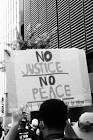
The Rittenhouse verdict was the exercise of arbitrary power. In that context in the US the rule of law would be a step forward. To achieve that the principle of no justice, no peace will be important.


Leave a Reply