
From the Making of the English Working Class to the Goldsmiths University Strike
Over 50 redundancies are currently planned at Goldsmiths College in London. They will hit English and History teaching and the equally important support staff. Goldsmiths UCU have voted for and are taking strike action to get the College to think again.
As Michael Rosen who teaches at Goldsmiths has pointed out, behind the job cuts, lie further developments in the Business University. In summary Goldsmiths has sought financing from Lloyds Bank. Part of that, though not something they have discussed with staff or students, seems to be a plan to cut jobs. In other words what is dictating the kind of learning and education that goes on at Goldsmiths is not a search for knowledge and enlightenment but a financial agenda set by others. It is the neo-liberal University 2021 style.
It does represent a significant development in the Business University but the concept itself is not new. Indeed over 50 years in the late 1960s students and staff at Warwick University took action over the secret influence that Coventry business had gained over the new institution.
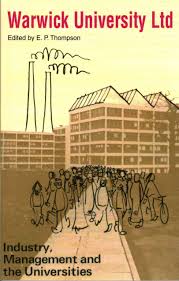
E P Thompson edited a Penguin Special Warwick University Ltd on the matter and was a lecturer himself at Warwick heading up the newly developed Centre for Social History. The Centre attracted postgraduate researchers such as Peter Linebaugh and David Montgomery impressed by Thompson’s The Making of the English Working Class (1963).
Thompson wrote in conclusion to Warwick University Ltd:
‘Is it inevitable that the university will be reduced to the function of providing, with increasingly authoritarian efficiency, pre-packed intellectual commodities which meet the requirements of management? Or can we by our efforts transform it into a centre of free discussion and action, tolerating and even encouraging “subversive” thought and activity, for a dynamic renewal of the whole society within which it operates?
Although Warwick represented a significant marker in the development of the Business University there was no talk at that time of shutting places like the Centre for Social History. Thompson and others were pointing to where the trend would lead-correctly.
Thompson was not in full agreement with all the tactics that the students used, although very much part of the protest. For him the parallel was the battle for the first Great Reform Bill in 1831/2.In 1831 significant protests in favour of reform took place but those involved had no influence or representation at all in the structures that eventually carried the reform in1832. Hence they could protest and hope. Thompson argued the same was true at Warwick and that protest should be made but end before the authorities tried to crush it (as they did).
Not all the students agreed. The wider parallel with Goldsmiths though is clear. The Making is all about the development of liberal (small ‘l’) and radical ideas and traditions in the English working class with a focus on knowledge and enlightenment. 60 years on from the Making that is what Goldsmiths is engaged in doing and what the new Business University wants to stop.


Leave a Reply