
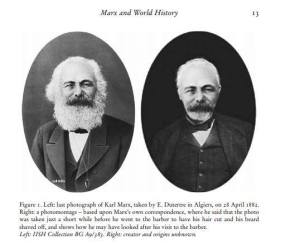
Why did Karl Marx have his iconic beard shaved off in April 1882?
The answer unfortunately as that we don’t really know. However below is an interesting speculation published in the Los Angeles Review of Books in 2018.
It’s a translation by Shelley Frisch of a section of Jurgen Neffe’s biography of Marx (2017)
Algiers, late April 1882. After an unusual period of cold weather with rain streaming down from black skies, a hot desert wind was driving temperatures up to more than 30 degrees Celsius. In his salon somewhere in the play of shadows on the cool back streets, a barber was sharpening his knives. Today they needed to be particularly sharp. An elderly gentleman with a bushy beard and white mane atop a strikingly high forehead had taken a seat in the barber’s chair, and this sedentary giant now looked far larger than when he entered the shop.
The man wished to shed his crowning glory, from his face and his head, probably on the advice of a doctor. He looked sickly, a little bloated, and drained by life. His eyes had lost their sparkle, but they flashed up briefly when he spoke and told jokes, thus providing the only indication of his true age. In a few days he would turn 64.
His overcoat, his demeanor, and his highly precise French identified him as a man from the north, yet with his bronzed complexion and dark brown eyes, he could have been from these parts. He also owed his nickname to the Moorish aspect of his features: his family and his German friend back home, now living in exile in London, called him “Moor.” That was how he signed his letters to his comrade there, and the name his three daughters had known him by since they were children. “Moor,” they said, “Moor is furious, Moor can go.” Not: “The Moor.” At the close of every letter he wrote them, he sent the young women his (always fond) regards, and signed his letters “Old Nick,” which, in English, stood for the devil.
Now the devil was playing his part. The knives were sharpened, white locks of hair were falling to the floor. In the mirror of an Arab beard shearer, Karl Marx saw himself taking leave of his familiar look. Like an actor who has finished performing and is sitting with his mask on, about to remove his makeup, he was bidding farewell to the character who had dictated his image throughout his life. He was destroying his image, his own graven image, molded after Zeus, a mighty bust of whom adorned his study at home. One last solitary act; World Theater without an audience.
One man was always on hand, even if he was not with him at that very moment: Friedrich Engels, his companion in England. As soon as they were separated they wrote letters to each other, and had been doing so for four decades by this point. Correspondence functioned as a substitute for keeping a diary. “A propos,” Marx, a.k.a. “Old Moor,” confessed his outrageous hair-cutting act to “dear Fred” from afar: “because of the sun, I have done away with my prophet’s beard and my crowning glory, but (because my daughters would rather have it this way) I had myself photographed before offering up my hair at the altar of an Algerian barber.”
His clumsy language reveals the decline that was putting a damper on the final year of his life. A few months earlier, when Marx lost his life’s companion, his wife Jenny, who had succumbed to cancer, Engels said, “The Moor has died as well.”
“Offering up my hair”: was this haircut a radical step that anticipated his own death, where the customer doesn’t get away unscathed? Or was it a symbol of liberation and a new beginning, as his relatively young age would still permit?
For the first time he had left the confinement of Europe. His letters and activities reveal his unwavering zeal and curiosity about the world, in accordance with the diverse interests of a man who had been passionate about politics and was now retired. During the final decade of his life he was no longer publishing anything of crucial importance, but he did produce countless memos and letters.
He had his last known photograph taken in Duterte’s photo studio, shortly after his arrival in late February. This picture was intended for his children and for posterity. Gazing into the camera, and beyond it into the darkness of the time that lay ahead, was a marked man who somehow knew that the worst was behind him. He looked a bit lost in reverie, smiling through his suffering. He confessed to his friend, “I’ve still been putting a brave face on an evil game.”
That was how he wished to be remembered and how he will live on in people’s minds: as a wise old man, and the image of an era that would not dawn until a long time after his death. Such was the gradual evolution of his historic role as an immortal who became the resonant container of human hopes for a better world.
In China, which reveres the elderly and hallows its ancestors and still calls itself communist with a keen sense of irony, this portrait remains his most popular likeness.
The beard — which had been one of the best known beards of all time — was now off. Without his aureole, his mighty head seemed small, almost frail, by comparison. By dropping his mask, which also kept his facial expressions so well concealed, Marx was exposing himself and, in a touching way, making himself invisible as well: no one would recognize him, although his likeness would soon appear on millions of posters. Now he could stroll down our streets, clean shaven and short-haired, as his own revenant. Marx without a full beard was like a clown without make-up or the Great Dictator without a moustache: he was a different person.
Someone posted a portrait of the shorn Marx on the internet. It amounted to little more than an amateurish retouching effort….The man laid to rest at Highgate Cemetery in London barely a year after the final cut at the barbershop in Algiers bore only a faint resemblance to the Olympian father of the gods that posterity would remember. After his appointment at the photographer’s, no more pictures of him would appear. There is no surviving photograph, not even sketches or even any mention of the old man with the bare face.
It is possible that such documentation once existed. If it had, it was probably destroyed by his daughters after his death, like all personally compromising letters, especially those between Marx and his friend, and between Marx and his wife. In light of this situation, how is posterity supposed to get a realistic picture of Marx’s personal life and personality? Generations of biographers have grappled with the question. Most have wound up skirting the issue and presenting whatever was available as the full picture.
If Marx’s trip to the barber, where he got to peer behind his mask, is mentioned in the Marx literature at all, it receives only anecdotal treatment as a whimsical act brought on by some sort of medical issue, most likely a skin problem. Not a thought about what this new look meant for him; whether the loss of self he orchestrated may have shocked or amused him. There is no attempt to explore the inner life of Marx as an individual, which would surely be of great interest. Indeed, Marx would point the finger unerringly at the hypochondriatic aspect of his constant suffering: “My illness always comes from my head.”
In works about Marx, readers generally search in vain for a discussion of the self-perception of this rebel, who could philosophize so inimitably about man’s self-awareness as a “species being.” These works read as though someone was merely playing Marx’s role, as a man cast into the world by history in order to complete his assigned tasks, rather than as a flesh and blood human being with eyes that couldn’t escape his own reflection as a profoundly solitary man. The question arises of whether he was able to feel sorrow in the situations he found himself in, or merely rage……
https://lareviewofbooks.org/article/the-last-journey-of-karl-marx/


Leave a Reply