
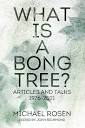
Michael Rosen’s What is a Bong Tree? The search for really useful knowledge.
Michael Rosen was kind enough to send me a copy of What is a Bong Tree (articles and talks 1976-2021) and in return I promised to write something about it.
That was some months ago and illness intervened, but I’ve been dipping into it when time allowed since. It is I think a dipping into book rather like Marx’s Capital and E P Thompson’s Making of the English Working Class, although it’s not that kind of book… It’s nearly 500 pages long and while I think there are themes that run through it, each piece is a stand-alone thing rather than just read it from start to end (though you could do that without a problem).
It must be noted that amongst the collection here there is nothing about Arsenal or beards. Perhaps that is to come in a subsequent volume. It should also be said that while I’m an historian and Michael Rosen focuses on literature and language, there are again underneath that unifying themes. There also links. Of course we both have beards and support North London football teams(just different ones). His late father Harold Rosen was at the Institute of Education in Bloomsbury and while I wasn’t there at that time, I did a PhD there over a rather longer time scale than the neo-liberal controllers of higher education would now allow. We are also of course socialists, perhaps with slightly different views on some things. As anyone on the left knows this means we should be sworn enemies but as Michael is now 75 and I’m half a generation younger at 65 whatever minor differences there may have been can be viewed in an historical framework now.
Reading through the various sections of the book I was struck (in due course) by the fact that a number seemed to read as Michael Rosen speaks. In the days of Zoom etc the interested person can fairly easily catch Michael in full flow and there is always social media too. I’ve pondered this. I write a fair bit, but what appears is most definitely not how I speak. As a veteran speaker at labour movement conferences, where a record is often kept, I’m often asked for my speech after I’ve spoken by the record keeper who can then make a note. They often look rather annoyed when I tell them there is no speech. I always speak ‘off the cuff’ perhaps with a few headline notes. I don’t know whether Rosen ever reads a speech or simply writes it up afterwards and both can work well but it does mean that at least to my ear the book contains the authentic voice of the author…
One theme I think I found in the book was that of the author looking at forms of writing, or forms required by Universities and others, which hindered rather than helped a search for meaning and understanding. Rosen seeks what might be called (and was called by the Chartists) really useful knowledge. That is something that can enlighten and perhaps inspire an attempt to change. That often means politics and the author writes of the Communist Party background of his parents (left 1957) and his own journey into and around the new left.
I found the piece headed Theory, Texts and Contents: a reading and writing memoir particularly interesting here. It seems to me that Michael Rosen writes poetry in the same as I write letters (or fletters). An attempt to express and understand. There is another link here too. One of the jobs my late father (who was also a CP member)had as a senior librarian in the London Borough of Haringey was to buy all the poetry books for all the Borough’s libraries. He wrote poetry himself unfortunately in a hand writing that made my indecipherable scrawl look like a model of readability.
Another piece which I read quite a few weeks ago now that has stuck in the mind is Exhibiting ‘Guernica’ 1939-2009 which is near the beginning of the book. It’s a fascinating account of politics and place (the East End) and history. I could go on (and often do) but hopefully the point is made that there is lots to read and think about here.
No doubt some reading this will also wonder what is a Bong Tree. The answer to this is Rosenesque and best found out by acquiring and reading the book.


Leave a Reply