
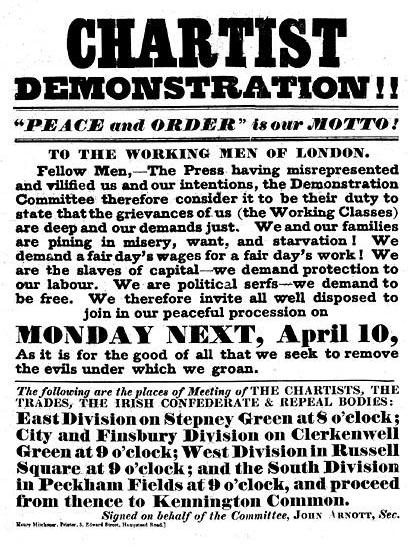
Chartist leader Feargus O’Connor MP on the Treason Felony Act. Commons 12th April 1848
Below is the speech Chartist leader Feargus O’Connor made in the Commons on 12th April 1848 in opposition to the Treason Felony Bill then before Parliament.
The Monday event he refers to was the Chartist demonstration for the vote held on Kennington Common on Monday 10th April 1848. The Whig Government were the forerunners of the Liberal Party founded in 1859
As O’Connor argued the purpose of the Bill was to criminalise protest and particularly criticism of the Monarch. Section 3 remains on the Statute Book in 2022:
Vulgar men would be allowed to preach throughout the country what doctrines they desired; of them no notice would be taken; but as soon as any one man, opposed to the Government, spoke advisedly, they would mark him out their victim
MR. F. O’CONNOR: The proceedings of Monday showed that the people were loyally disposed, and consequently that no such measure was necessary. The prosecutions which had taken place in 1839, 1840, and 1841, were quite sufficient to show that the existing law required no strengthening; yet this measure was brought in by the Whigs. It was the pride of the Whigs of former days to be opposed by the Tories; but it was the guarantee of the Whigs of the present day to be supported by the Tories. This measure, if passed, would be a disgrace to the Statute-book, and a dishonour to the Go- 230 vernment. Let them pass this Bill, and that which was the safety-valve of the constitution being fastened down, discontent would at once explode; there would be no more an opening for the expression of public opinion. Vulgar men would be allowed to preach throughout the country what doctrines they desired; of them no notice would be taken; but as soon as any one man, opposed to the Government, spoke advisedly, they would mark him out their victim. Well; and if they were to fill the hulks with martyrs, he would tell them that for each martyr ten thousand new men would arise eager and willing to step into his place, and to bide the event. It was impossible that they could maintain Ireland in her present position. Something must be done for her, and that speedily. This Bill would not put her down—this Bill, which he denounced as treason against the Crown, and the person of the Sovereign. Such a Bill he never expected would have emanated from a Whig Ministry; in consequence of it, they had become the most unpopular Government that had ever possessed the reins of power in this country. Was it not well known that the Government had the power of selecting the judge and the jury? What chance, then, was there for the liberty of the subject? He entreated the House, he entreated the Government, to give the people an opportunity of expressing their opinions upon the Bill. He besought the noble Lord not to disgrace the high name he bore by thus pressing such an unconstitutional measure. He did not mean to taunt the present men in office with the treatment which he had personally received at their hands. He considered that it was but right that those who led the people should suffer any penalty which might attach to their position. He protested against a reformed Parliament thus stealing a march upon the people; he protested against the Bill, because he was a loyal subject, and because he objected to Her Majesty’s becoming tinged by the disloyalty of Her Ministry. He could not find language sufficiently strong to denounce his abhorrence of it. If folly or treason were spoken at a public meeting, the good sense of those present would put the surest extinguisher upon it. He had never allied himself to secret societies—he never would; but let them pass that law on that day, and on that day week hundreds of secret societies would be organised throughout the kingdom, which sooner or 231 later would result in a storm that would swamp the Government, and shake the empire to its foundations. Let not the noble Lord despise his warning—to be forewarned was to be forearmed
https://api.parliament.uk/historic-hansard/commons/1848/apr/12/crown-and-government-security-bill


Leave a Reply