
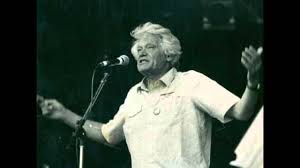
After Starmer wraps Labour Conference in the Union Jack E P Thompson on ‘progressive patriotism’
The site of a Labour Conference in Liverpool with a Union Jack stage set up and delegates singing God Save The King reminded that this social chauvinism is not the only version of patriotism available (I’m an internationalist)
Below I touch on how complex the subject is by looking briefly at the attitude the late socialist historian E P Thompson had to it.
Thompson of course was an internationalist, someone who spent years of his life as a leading figure in European Nuclear Disarmament (END) seeking solidarity with people across Europe and someone who as an academic spent a good deal of time discussing with and meeting fellow historians across the globe.
Yet Thompson while he left the Communist Party in 1956 came up in a tradition that was framed by the British Road to Socialism and was someone who described himself as a Great Bustard. The Bustard is extinct in the UK primarily because it could not fly easily and hence was confined to British soil.
In his open letter to Leszek Kolakowski (1973) Thompson compared himself to the great bustard, grounded and unable to fly with wider intellectual developments. Rather he saw himself as part of a distinctively English tradition which as he noted had strengths and weaknesses:
But I cannot fly. When you spread your wings and soar into the firmament where Kierkegaard and Husserl, Heidegger, Jaspers and Sartre and the other great eagles soar, I remain on the ground like one of the last of the great bustards, awaiting the extinction of my species on the diminishing soil of an eroding idiom, craning my neck into the air, flapping my paltry wings. [13] All around me my younger feathered cousins are managing mutations; they are turning into little eagles, and whirrr! with a rush of wind they are off to Paris, to Rome, to California. I had thought of trying to join them (I have been practising the words “essence”, “syntagm”, “conjuncture”, “problematic”, “sign”) but my wings grow no bigger. If I were to try I know very well that with my great bulk of romantic moralisms, my short-sighted empirical vision, and my stumpy idiomatic wings, I would fall – plop ! – into the middle of the Channel.
I belong to an emaciated political tradition, encapsulated within a hostile national culture which is itself both smug and resistant to intellectuality and failing in self-confidence; and yet I share the same idiom as that of the culture which is my reluctant host; and I share it not only through the habits of a writer but out of preference. This, if I am honest, is myself, my sensibility. Take Marx and Vico and a few European novelists away, and my most intimate pantheon would be a provincial tea-party: a gathering of the English and the Anglo-Irish. Talk of free-will and determinism, and I think first of Milton. Talk of man’s inhumanity, I think of Swift. Talk of morality and revolution, and my mind is off with Wordsworth’s Solitary. Talk of the problems of self-activity and creative labour in socialist society, and I am in an instant back with William Morris – a great bustard like myself, who has never been allowed into the company of such antiquated (but “reputable”) eagles as Kautsky or Plekhanov, Bernstein or Labriola – although he could, if given the chance, have given them a peck or two about their gizzards.
Well, that is what I am, and it is a ludicrous predicament. It is an excuse for any amount of silence. Holding for too long, and with too few companions, to an unregarded position breeds – as this letter has already shown – symptoms identical to those of egotism. I have become too much aware, in my silence, of the motions of my own mind; too detached from the thought around me into which my own argument can never be inserted; too stubborn in resistance to assimilation.
Unfortunately E.P. Thompson died aged 69 in 1993 so we cannot know what his thoughts on the 2016 Referendum might have been. His criticism of what is now the EU is clear, but his concern at being isolated from wider European culture suggests that he had in mind the pursuit of a European unity of a rather different kind. That of solidarity and socialism. Progressive patriotism or internationalism….. part of a national culture but in opposition to it. It’s complicated


Leave a Reply