
Cuban Missile Crisis 62 years on. Nuclear war takes two..
Rishi Sunak has claimed that there is more danger of a nuclear war than at any time since the Cuban Missile Crisis, sixty two years ago. Certainly Putin has been rattling his nuclear weapons but its notable that Zelensky has previously talked of ‘strikes’ on Russia (obviously he misspoke and meant sanctions…)
I was 7 at the time of the Cuban Missile Crisis and can remember nothing at all about it. You’d need to be around 75 to have the drama of those days in October 1962 lodged in your mind. Rishi Sunak is 44.
Fortunately the details of the crisis, one of the key points in the long Cold War between America and the USSR, are now in the public domain and extensively so.
America under Kennedy, was hawkish and wanted to destroy the socialist experiment in Cuba. It had launched a failed invasion, the Bay of Pigs, in 1961. Russia was equally keen that Cuba remained out of US control. Hence the placing of Russian missiles on the island.
After a tense stand-off when the use of nuclear weapons by both sides appeared very likely a secret agreement was reached. The missiles were withdrawn and the world stepped back from the brink of nuclear war.
What impact did these events have on those who lived through them and what positions might they underwrite today?
One obvious debating point is whether the fact that nuclear war did not actually occur meant that Mutually Assured Destruction the aptly named MAD did mean that nuclear weapons in fact acted as a deterrent to war.
Historical ‘what if’ questions provoke no definite answers but it is reasonable to suggest that this is a view provided with hindsight that would not have found popularity in the final weeks of October 1962.
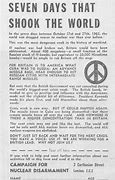
There were CND demonstrations on the issue and leaflets issued, but if you calculate that the end of the world is likely to be coming it may be that you would have other things on your mind.
A CND leaflet produced just after agreement was reached between the US and USSR called 21-27 October ‘crisis week’ and the ‘most dangerous week in the history of mankind’.
The particular concern in Britain was that the country held US nuclear weapons which were in range to attack the East. Likewise the East could easily attack Britain with nuclear bombs. A dispute over Cuba might very easily start with the nuclear destruction of this country.
We now know that 60 or so British nuclear weapons with US warheads were on 15 minute notice to be launched at the USSR during those October days
We can get a flavour of this from accounts at the time.
The late Labour MP Frank Allaun noted that in the final days of October 1962 people went to bed at night aware that they might not be alive in the morning.
Veteran CND campaigner the late Pat Arrowsmith and her partner, believing that nuclear war was more certain than not and with the certain obliteration of Britain as a result, fled to the comparative safety of the south-west tip of Ireland. The story made the news media and was used to ridicule them after the crisis was averted. From the perspective of those days however it may well have made some sense.
Certainly the Cuban missile crisis underwrote the perspectives of a generation of the left in much the same way that more recently the Iraq War has done for a more youthful cohort of activists.
Now as 62 years ago debates about whether the very system itself led to war or whether such events can be regulated and controlled were an important part of the political landscape
The world did not end in late October 1962. But nuclear weapons are still with us and the world remains a very dangerous place.


I wonder if the Cuban missile crisis really affected the whole world or whether as in so many other cases events in or centred on USA get greater news coverage here than events in other parts of world. I was 22 in 1962 hitching round Europe N Africa . In October I was grape picking in small villages in LANDOC SW France . Only news of outside world we received was of one of de Gaulle referenda taking place at the time. I remember receiving a letter from friend in England a little later repeating what you said of going to bed thinking you may be dead by morning.
I was not only aware of what was going on in Oct 1962 but was in Grosvenor square outside the – then – US embassy. Afterwards we were told that the bus-loads of police parked around the corner were there to protect us against US sharpshooters inside the embassy who would shoot to kill if any of us had managed to storm it. Nonetheless I remember being crushed against the railings as we were charged by police horses. There is much more to it than has survived as “history”. First there is some evidence that there were actually no functioning missiles on Cuba it was a US trick which Cuba turned into an effective bluff. (See the fictionalised account in Amy Gdala’s The Odds are Even) . But an even more complicated angle comes from Paul Rogers who, only last week, claimed that MAD never actually was US policy and that “tactical” or “limited” use had always been on the cards to be used as on Hiroshima and Nagasaki as a warning demonstration to putative enemies. Despite the fact that our tremendous turnout in Feb 2003 showed that governments set on war take no notice of public opinion it is still VITAL that we show up on Nov 5th this year in even larger numbers : No to war, NO to NATO – welfare not warfare!We must promote this in every way we can. As a continuing supporter of Historians- for- a- Continuing- Supply- of- History and fletterist you have a key role here!
solidarity, Julie