
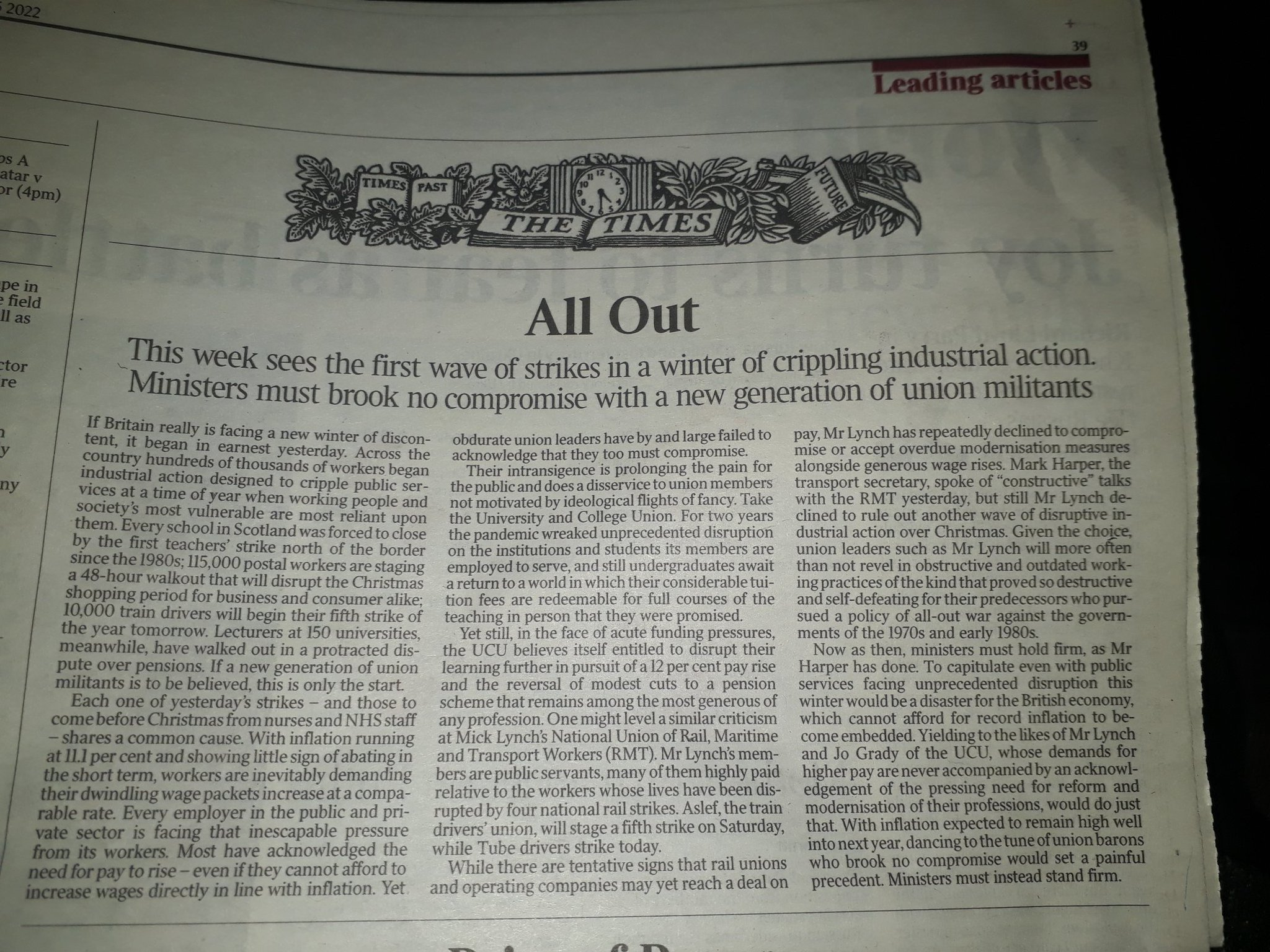
The past weighs like a nightmare on the brain of the living. Industrial action 1970s-2020s
Industrial action is back. The CWU, RMT and ASLEF are engaged in national strike action- albeit discontinuous. The UCU has just finished there days of strike action. The RCN, PCS and others plan action in December.
The reason, in the main, is easy to grasp. Inflation stands at 11%+ (food inflation is higher) and offered wage rises are nowhere this. Many are struggling to pay bills. Strike action is a last resort but a necessary one if employers, who are mostly not themselves in hardship, won’t negotiate an appropriate rise in pay.
The late socialist historian E P Thompson was fascinated by commentary in the Times in an earlier(and much larger) period of strike action the 1970s. Some of this is captured in his collection, Sir, Writing By Candlelight.
I turned to the Times (Editorial 25th November) to see how things have moved on in the last 50 years. It appears that at least at the Times the past weighs like a nightmare on the brain of the living. There is much reference to ‘union barons’. Yet union leaders like Mick Lynch and Jo O’Grady have to be elected in a postal ballot by union members. I don’t think traditionally barons are elected.
Secondly to take industrial action requires not only a majority of union members to vote for it, again in a postal ballot, but at least 50% must vote. In short unless the mood of members is to take action it doesn’t happen whatever the barons say.
The Times also complains that unions are against modernisation but doesn’t quite get around to mentioning what that means. On the rails for example it means for example less station staff to help the many who need it when buying tickets and boarding trains. Not very modern really.
Lastly the Times say that inflation pay rises cant be afforded. Obviously if the aim is to get ordinary people to pay for a Truss inspired financial mess they can’t be. If the idea is to avoid recession and make sure people have money to spend on goods and services- which translates into jobs and profits- then perhaps they should be afforded. There is nothing even vaguely radical about this so perhaps the Times will get round to thinking it in due course.
Update 3rd December
As the unions still havent agreed to The Times demands another Editorial has appeared (3rd December). Rupert Murdoch’s finest call for a minimum service during strikes law which it is admitted is all but unworkable. Heavy fines for unions are mentioned as someone has clearly recalled Heath’s (failed) National Industrial Relations Court from the 1970s. It has agreed that the right to strike does exist (albeit only in the negative, The Times is not great on employment law) but not if it annoys Times readers. A classic text for future labour historians


Leave a Reply