
When Christmas was banned (1644-1660)
From 1644 until 1660 the celebration of Christmas was officially banned in England.
The reasoning of Puritans and Cromwell’s Parliamentarians for this, as well as Catholic opposition to it, is important but for further posts. Below is an edited summary of what the ban meant in practice.
The words are written by Keith Down of the Royal Armouries Museum in Leeds
Christmas was banned in Britain by a 1644 Act of Parliament, with the Long Parliament of 1647 passing a law which officially abolished the feast of Christmas making its celebration punishable. The ban remained in place until the restoration of the monarchy in 1660.
Puritans wanted Christmas Day to be a day of fasting and humility, but otherwise a normal working day – not a Feast or Holy day as it had been in the past. Indeed, MPs sat in Parliament on Christmas Day 1643 as though it was any other day of the year. Such measures were not uniformly popular, even in Parliamentarian-dominated London. That same Christmas, for example, some angry Londoners keen to follow the old traditions of Christmas, attacked shops that opened.
In January 1645 Parliament set up a New Directory of Public Worship which stated that there were to be no Holy Days apart from Sunday. In June 1647 Parliament passed an ordinance which confirmed the abolition of Christmas, Easter and Whitsun and during the 1650s (during the Commonwealth) legislation put in place penalties on those found attending special Christmas church services, or for closing their businesses for the day. In 1657 the Council of State urged the mayor of London to clamp down on celebrations.
Enforcement of the legislation was another matter, whilst some church ministers were arrested in 1647 for preaching Christmas sermons, many people continued to celebrate the season despite Parliament’s official position. The fact that Parliament had to keep issuing proclamations against Christmas throughout the 1650s shows that, until later on in the decade, many people ignored the prohibition.
Royalists saw the victorious Parliamentarians as ‘killing off’ Christmas. One Royalist ballad of 1645 complained that “Christmas was killed at Naseby fight” – a reference to a major Royalist defeat by Parliamentary forces at the battle of Naseby on 14 June 1645. Royalist clergymen also engaged in writing pamphlets defending the celebration of Christmas and the importance of passing on these traditions to the young.
At Christmas in 1647 in Canterbury the town crier had proclaimed the committee’s commitment to the suppression of Christmas. In response a large crowd gathered to demand the usual traditions be observed. Eventually a riot broke out, forcing the mayor and several magistrates and clergymen out of the town. A few months later Kent rose in revolt in the name of King Charles I. Christmas also remained particularly popular among England’s community of Catholics or ‘Recusants’, who regarded the celebration of Christmas and devotion to the Virgin Mary as essential tenets of the faith.
Christmas traditions really stayed the same from the Middle Ages and throughout the Civil Wars. In many ways, we still observe them today. Despite the official ban many still decorated their homes and doorways with holly, bay, ivy and rosemary. People gave gifts especially to the young and the poor, attended church services, feasted and drank copious amounts of alcohol – including ‘wassailing’ which involved going from door to door singing and drinking from a communal wassail bowl whilst wishing people good health.
Carol singing was an important part of Christmas and some MPs complained that their neighbour’s preparations for Christmas had disturbed their sleep. Mince pies (made with real minced beef) were eaten, as was plum pudding. Morris dancing was another feature of Christmas, as was gambling. As I mentioned previously, Catholics were particularly attached to Christmas and were known for their great Christmas festivities. Some Catholics may have attended illegal Catholic masses in the homes of wealthy Catholic gentry and nobility – one aspect of the Christmas tradition they would have had to have kept secret from the authorities.
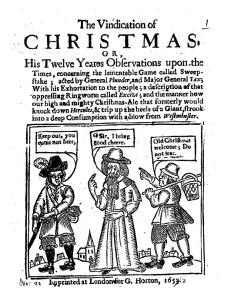
‘Sir Christemas’ had appeared in song in the 15th century, but certainly in the 17th century the personification of Old Father Christmas served as a means of defending the season from Puritans, after all people can generally relate much better to and empathise more towards a person than an idea. In the 1652 ‘Vindication of Christmas’ published by the Royalist John Taylor, a bearded ‘Father Christmas’ defends himself as only bringing “good cheere”
In 1658 Josiah King published ‘The Examination and Tryall of Old Father Christmas’ in which ‘Christmas’ is depicted as a white-haired old man on trial for his life – certainly a deliberately sympathetic image, and naturally ‘the jury’ acquits him. I’m not sure when Christmas is first depicted as an old man, but certainly by the late 16th century.


Leave a Reply