
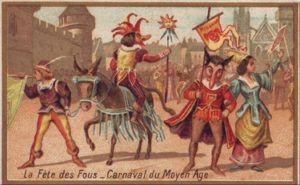
The Feast of Fools & black puddings. Some historical questions
The Feast of Fools was part of the traditional 12 days of Christmas and took place around January 1st.
It was a world turned upside down affair where authority (in Medieval times that meant religious authority) was relentlessly mocked. Needless to say over time authority hit back and there is little evidence of the feast beyond the eighteenth century.
It was more celebrated in France than England and the example below is from the former country. However there is evidence, via complaints, that the Feast of Fools was marked in places such as Exeter, Lincoln and York and eating black pudding at the altar of the Church was cited in the complaints (Reading Museum).
Black puddings, boudin noir, were seen as delicacies in the Middle Ages which may explain their otherwise rather surprising role in the proceedings.
Priests and clerks may be seen wearing masks and monstrous visages at the hours of office. They dance in the choir dressed as women, panders or minstrels. They sing wanton songs. They eat black puddings at the horn of the altar while the celebrant is saying Mass. They play at dice there. They cense with stinking smoke from the soles of old shoes. They run and leap through the church, without a blush at their own shame. Finally they drive about the town and its theatres in shabby traps and carts, and rouse the laughter of their fellows and the bystanders in infamous performances, with indecent gesture and verses scurrilous and unchaste.
Letter from the Faculty of Theology University of Paris 12th March 1445
The most recent research into the Feast of Fools is Max Harris’s Sacred Folly (2011). This is a revisionist account which argues that it suited the Clergy to exaggerate the nature of the event and confuse it with the secular Kalend festival.
Reviewers have both praised Harris’s careful scholarship but raised the issue about whether the ‘confusion’ between religious and secular festivals was not in fact genuine and that the level of complaint about the Feast of Fools over a sustained period does suggest that there were real ‘world turned upside down’ fears.
More research is needed now on instances of subversion at the year-end period and for those interested in the role of black pudding in it, some detail on that too…


Leave a Reply