
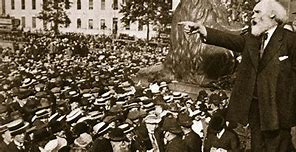
131 years of the Independent Labour Party
131 years ago this month, on the 13th January 1893, the Independent Labour Party was formed in Bradford. Keir Hardie was elected as the first Chair. There has been little to mark the anniversary, even though independent Labour politics remains a significant issue thirteen decades on.
The ILP ceased to exist as a party by the mid-1970s having broken with the Labour Party in the 1930s. Labour in its current form has little interest in remembering its own history. Even so the founding of the ILP does have important pointers for socialists today.
As E P Thompson noted in his essay on an early ILP activist Tom Maguire, the ILP began not in a London Head Office but in ‘those shadowy parts known as the provinces’. Thompson argued that ‘when the two party political system began to crack, a third party with distinctively socialist character emerged amongst the mills, brickyards and gasworks of the West Riding’
It was a socialist politics built from the bottom up and trade union organisation and struggles were central to it. Attendance at the Bradford conference was comprised very largely of socialists from Scotland and the north of England but organisation soon developed in the rest of England and Wales.
So also was the independent stance. Labour politics in the final quarter of the nineteenth century remained dominated by the Liberal Party. The ILP represented a break from that, albeit one that took a while to fully work through. There are those, and Tony Blair regularly makes the point, who see the break from a Liberal ‘progressive’ politics, and by extension the involvement of trade unions as a mistake. That is one very good reason to keep the history of the ILP firmly in mind.
Engels near the end of his life welcomed the formation of the ILP and contrasted its open nature with the politics of the Social Democratic Federation, which styled itself as a Marxist party. Socialist politics in the 1890s were relatively fluid in organisational terms and there was certainly some crossover between ILP and SDF activism.
The ILP however focused its political campaigns on reforms around things like welfare, an eight-hour day and a minimum wage. The SDF was generally dismissive of ‘palliatives’ arguing formally for the abolition of capitalism, while calling for some reforms in its programme
The ILP, the SDF and trade unions came together in London on 27th February 1900 to form the Labour Representation Committee. The focus was on getting socialist MPs elected and the main membership organisation with the capacity to do this was the ILP.
This changed in 1918 when the Webb’s Constitution saw a Labour Party with individual membership come into existence. The ILP as an adherent of the Second International had supported the First World War although numbers of its activists were anti-war. Ramsay McDonald, opposed the war and in 1918 at the Leeds Conference called for Soviets.
When the Communist Party of Great Britain was formed in 1920 a minority of the ILP left looked to join. McDonald and others Labour MPs who were ILP members had other ideas. By 1924 McDonald was leading a minority Labour Government and the Times was praising him as the future of socialism against the recently deceased Lenin.
We can see why Engels was enthusiastic about the ILP in the years before his death in 1895. It was not of course because he foresaw the likes of McDonald laying down something of template for future Labour administrations. Rather it was because at its grassroots the ILP did represent a genuine workers movement with all the different trends and arguments about how to achieve socialism that this meant
This post originally appeared in the Morning Star


Leave a Reply