
126 years since the Labour Representation Committee was formed. What did the first Labour MPs read?
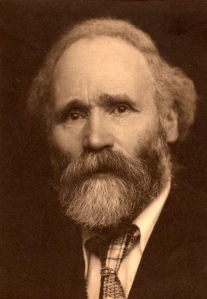
by George Charles Beresford, sepia-toned platinotype print, 1905
The Labour Representation Committee was formed at a conference held in Farringdon St on 26 & 27th February 1900. Its aim was to secure Parliamentary representation for the interests of working people, that is ‘labour’. It was not to obtain a majority Labour Government. Such a matter was un-thought of at the time.
The building still stands (much modernised)and the Memorial Hall is marked by a plaque. I covered the offices it now accommodates as a union officer for many years.
In 1906 29 MPs were elected under the LRC banner and the Parliamentary Labour Party was formed. The vote for who should lead it was tied on the first round and on a subsequent vote Independent Labour Party member Keir Hardie just edged ahead.
Naturally there was a good deal of interest in who the 29 Labour members were.
Many were from Lancashire- where the Liberal vote had been weak but anti-Tory feeling still strong. There were also trade union officials and leaders with a minority being ILP socialists like Keir Hardie, Ramsay MacDonald and Philip Snowden,
There were no women- female suffrage did not yet exist. The split between moustaches and beards in the ranks of the LRC MPs was more or less even with Philip Snowden clean shaven.
W T Stead Editor of the Reviews of Reviews sent a questionnaire to the 29 MPs asking them about their reading habits and favourite books.
Stead and more particularly the only significant commentary on Stead’s piece by Bealey and Pelling (1958) are quite condescending about the responses received, unjustifiably so.
Hardly any of the 29 had read Marx and only a few any work by a well-known socialist such as Robert Blatchford.
Will Thorne, a Marxist and an SDF member had read Marx while Charles Duncan an ILP member had read Blatchford’s Merrie England and George Barnes was familiar with the work of William Morris. Some had read Fabian Tracts
Leading ILP member Philip Snowden meanwhile said he had been influenced by an American critic of socialism, Richard T Ely.
I’m not sure that it is really a huge surprise that few of the 29 LRC MPs of 1906 could be called committed and well-read Marxists.
What is perhaps more interesting is the depth of their, at least professed, reading across more general works. Some had consulted the Bible which is hardly a surprise as nearly all the 29 MPs were Methodists. It’s fair to say that from its pages they had taken some kind of radical thoughts.
Others had read Henry George- who wrote on land nationalisation- and numbers were familiar with Charles Dickens and Thomas Carlyle.
Overall those 29 MPs- the first to represent the Labour Party in Parliament were a well-read bunch. They were mostly not well up on the Marxist critique of capitalism but they had certainly read widely on what might be called the ‘human condition’, about poverty and the struggle to survive in a profit led society.
Most were union officers who most on the left nowadays would regard as being uncomfortably close to the interests of the employer.
However, as with Taff Vale, the employer wasn’t always interested in having a close or any relationship with unions. Those MPs did at least have a reasonably good grasp, through experience and reading, of the conditions those who voted for them experienced, even if they didn’t always do much about it.

 Kmflett's Blog
Leave a comment