
18th March: thousands march to defend refugees;Michael Rosen’s Missing explains why it needs to be done again & again
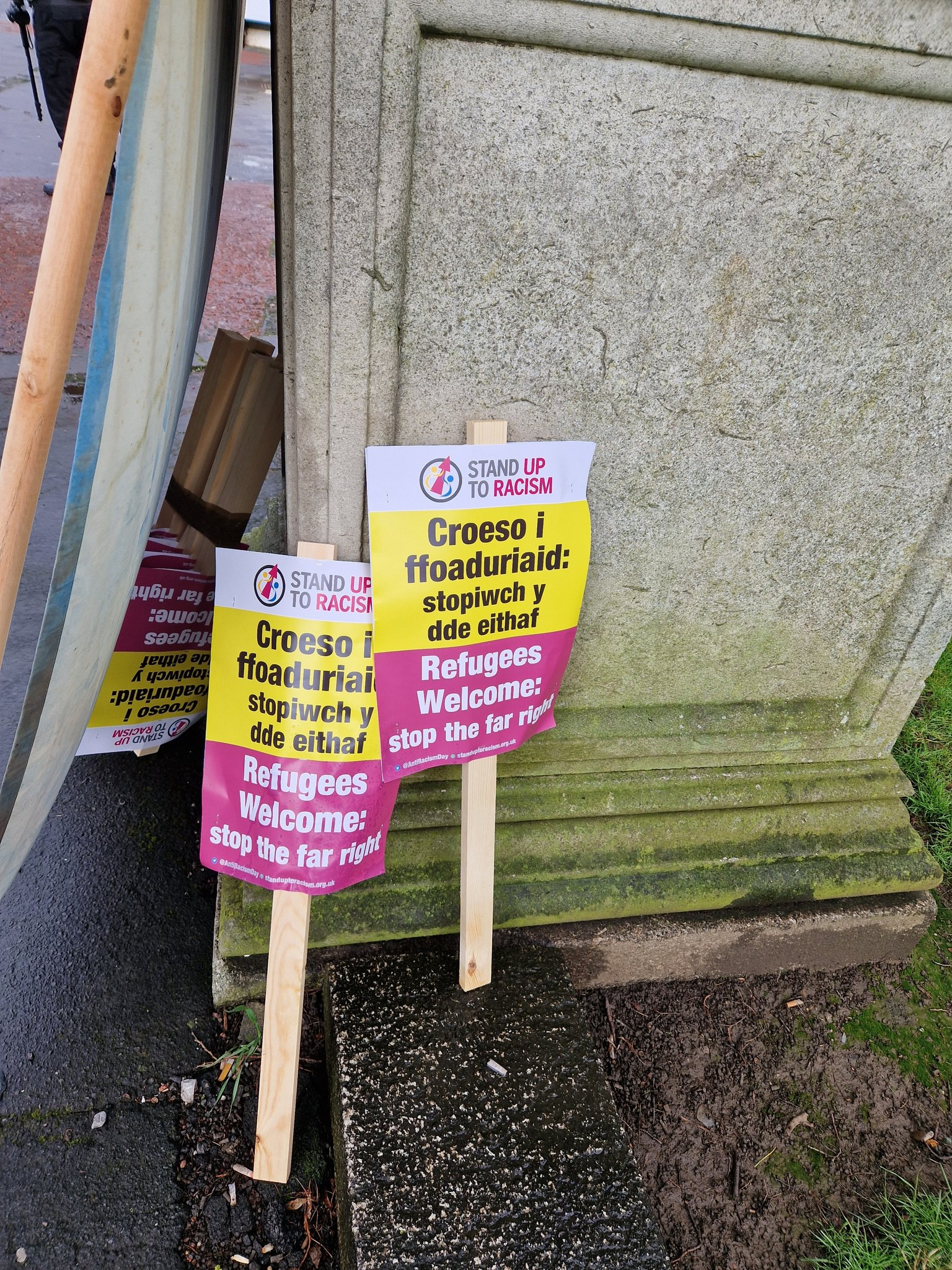
Thousands marched in London, Glasgow and Cardiff on Saturday to defend refugees and protest Suella Braverman’s latest Parliamentary attack on the right to asylum. I was at the Cardiff demonstration which had a broad range of people and speakers and no rain.
The issue of refugees fleeing from wars and oppression has become even more of a focus with the Russian invasion of the Ukraine. There are regular (though often little reported) attempts by refugees from Libya and elsewhere to get into Fortress Europe. Not all make it.
Meanwhile in the parallel Fortress Britain Suella Braverman has spent time promoting ever harsher measures against entirely legitimate refugees.
To find out where this kind of politics leads, a read of Michael Rosen’s The Missing is essential
I wrote the below three years ago on 6th February 2020 and all things considered, albeit with absolutely no thanks to Boris Johnson, it’s good that Michael Rosen is still around to speak about his family and the process of historical inquiry that led him over 20 years or so to piece together the story published as The Missing.
I went to school in Muswell Hill in the 1970s. It was a left-wing (comprehensive)school and the history of fascism and war was certainly not hidden. At the same time I did not start to learn about the Holocaust and its dreadful impact until I became active as a socialist in 1974.
There is some historical work needed to address what remains an absence in too many people’s understanding of recent history. I think the view was that as the Nazis had been defeated, the world had moved on from all that. In Britain with the demise of the Mosleyites, fascism while still around was a marginal presence. Then came the rise of the National Front from the early 1970s as a significant electoral force and to a degree as a street gang. I recall from that time in North London socialist meetings being attacked and smashed up by fascists. In those times I didn’t venture out without keeping a close eye on who was coming the other way and wearing a pair of DMs (Doc Marten shoes with steel toe caps not direct messages for younger readers). Yet the Cable St mural marking the victory of 1936 was not started until 1979.
Hopefully matters have in some ways improved a bit since, not least due to the efforts of Holocaust survivors and anti-fascists and anti-racists to make sure that the history of the Holocaust and what it meant is told and understood in each new generation.
Michael Rosen’s book is an important part of that. It tells a story of what happened to people simply because they were Jewish. Never again.
Amongst other things I’m a research historian. I convene the socialist history seminar at the Institute of Historical Research at the University of London School of Advanced Study and have done for many years.
As socialist historians we’re left-wing of course but we’re robust in our research. Rigour is expected as are awkward questions and uncomfortable findings.
Rosen is known as an author and broadcaster, a socialist and anti-racist and come to that a beard wearer and Arsenal fan.
He is not known as a research historian but that doesn’t mean he can’t be one. After all the great socialist historian E P Thompson started out teaching English literature and only stumbled into history as a byway initially.
The Missing is a brief volume of short chapters and some poems.
It does have references and an index at the end but it lacks the kind of academic apparatus that we look for in research history. Where for example are the footnotes??
Partly the answer is that the Missing is a book aimed primarily at young people, aiming to get across in deeply personal terms what the Holocaust actually meant.
But partly it doesn’t matter. Rosen has spent decades researching his family history and the research methods cannot be faulted.
Of course in the 2020s the internet can be helpful but can’t be relied on as a definitive source. Rosen doesn’t do that. He seeks out obscure books that mention his family and contacts libraries in France to see if they have any records.
What he finds doesn’t make for particularly happy reading but it is important, vital, even reading for our times.
He notes:
With every passing year, the number of Holocaust survivors gets smaller. We need to keep them the memory of them alive: the people who died and those who survived. That’s partly why I wrote this book.
The other reason, Rosen notes, is because the wider message of The Missing is about refugees and that is still with us, although those in political power in the UK at the moment would clearly prefer that it wasn’t.
That means the book is not only fascinating and important history but it has relevance now, as the best history should have.
And the awkward questions raised? Surely why there is not more research on this that gets out of the seminar room and into the public domain, because it needs to be read, understood, discussed and in times like these acted on.
See you on more protests to defend refugees from the Government’s racist agenda then


Leave a Reply