
The Hot Cross Bun: Inventing and Reinventing tradition
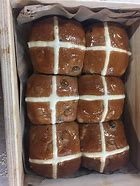
Below is an extract from the best guide to mid-nineteenth century London written by the social commentator Henry Mayhew. It underlines that by the 1850s the Good Friday sale of hot cross buns was a significant business. Fast forward 170 years and the sale of hot cross buns is no longer confined to one day but spread across an entire season. The original commercial invention of hot cross bun selling has been reinvented in modern times and buns can now be found in savoury as well as sweet style.
London Labour And The London Poor
Of The Street-sellers Of Hot-cross Buns: By Henry Mayhew, Published 1851
Perhaps no cry—though it is only for one morning—is more familiar to the ears of a Londoner, than that of, “One-a-penny, two-a-penny, hot-cross buns” on Good Friday … One London gentleman, who spoke of fifty years ago, told me that the street-bun-sellers used to have a not unpleasing distich [a unit of verse consisting of two lines] … It seems hardly in accordance with the usual style of street poetry:—
“One-a-penny, two-a-penny, hot-cross buns! If your daughters will not eat them, give them to your sons.
But if you hav’n’t any of those pretty little elves, You cannot then do better than eat them all yourselves.”
The sellers of the Good Friday buns are principally boys, and they are of mixed classes —costers’ boys, boys habitually and boys occasionally street-sellers, and boys street-sellers for that occasion only. One great inducement to embark in the trade is the hope of raising a little money for the Greenwich Fair of the following Monday.
— [“On Easter Monday breaks out, in all its depressing vulgarity, Greenwich Fair—a melancholy exhibition of national merriment,—when drunkenness too often supplies the place of natural jollity, and brutality tramples under foot everything like rational recreation”. From ‘The Illustrated London Magazine’, Published 1855] —
I am informed that 500 persons are employed on Good Friday in the streets of London in the sale of hot-cross buns, each itinerant selling upon the day’s average six dozen halfpenny, and seven dozen penny buns, for which he will take 12s. 6d. (his profits being 3d. in the shilling or 3s. 1 1/2 d.). One person informed me that last Good Friday he had sold during the day forty dozen penny buns, for which he received 60s.
The bun-selling itinerants derive their supplies principally from the wholesale pastrycooks, and, in a less degree, from the small bakers and pastrycooks, who work more for “the trade” than themselves. A vendor of ” hot-cross buns” has to provide himself with a basket, a flannel (to keep the buns warm), and a cloth, to give a clean appearance to his commodities. These articles, if bought for the purpose, cost—basket, 1s. 6d.; flannel and cloth, 2s.; stock-money, average, 5s. (largest amount 15s., smallest 2s. 1/2 d.) or about 10s. in all. There is expended in one day, in hot-cross buns purchased in the London streets, 300l., and nearly 100,000 buns thus bought.


Leave a Reply