
10th April 1848. Where did the Chartist protest for the vote go wrong?
178 years ago on 10th April 1848 the Chartists held a rally to demand the vote for working men on Kennington Common. It was the first demonstration in the world to be photographed and the original picture is held in the King’s Collection at Windsor.
This gives an indication of how seriously the ruling class took the threat of a revolutionary outbreak, with much of the rest of Europe in turmoil. The Queen departed for the Isle of Wight and troops and special constables were mobilised to protect key buildings and deal with any Chartist challenge to power.
The efforts of the State on 10th April 1848 are relatively well documented. The Chartist tactics for the demonstration has received less attention
The numbers on the day are disputed but certainly over 100,000 gathered on the Common. In the days before the telephone, let alone mobiles, organising such a protest had to be done in ways which are still in part familiar. London was placarded with details of the demonstration. Chartist branches around the Capital organised for the protest and passed details of it by word of mouth.
Unlike today it was a purely London demonstration. The idea of a London protest being a national focus was some time off. Train travel was in its relative infancy and the time and cost were out of the reach of workers.
The day chosen for the protest, a Monday, is also unusual to modern eyes. Strike action was not involved. Rather the practice of Saint Monday extending a day off on Sunday to the next day as well remained commonplace, certainly amongst the small scale trades that were a feature of the London working class in 1848.
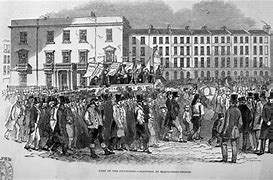
The historic photograph of the demonstration is thought to have been taken before the numbers attending peaked but it reveals a number of speaking platforms across the Common. In the days before loudspeakers this was the only way that at least a portion of the crowd could hear.
Chartist leader Feargus O’Connor reached an agreement with the police that while the rally on Kennington Common could go ahead no mass demonstration to Parliament would be allowed. The Chartist left organised by the black leader of London Chartism William Cuffay were determined to march.
There were clashes with police and soldiers on the south side of Blackfriars bridge. As delegates at the Chartist meeting the following day noted as soon as marchers from various points north of the Thames had crossed bridges, the authorities moved in to bar the reverse journey.
In the event, something that is still very familiar to those who attend demonstrations today intervened. It rained and marchers dispersed.
The point about meeting south of the Thames was however raised.
A leader of left Chartism, George Julian Harney who worked with Marx and Engels, made his position on this clear at a Chartist delegate meeting on 11th April.:
‘He would never again consent to leave London to hold a meeting’ reported the Chartist Northern Star paper on 15th April 1848.
Harney was clearly not a fan of South London, although Kennington Common was a traditional radical meeting place when few were available. The Royal Parks for example were occupied by police and soldiers.
There is a question however of why the Chartists did not meet north of the river. Copenhagen fields in North London, scene of a mass rally to defend the Tolpuddle Martyrs was still available in 1834. The march to Parliament would have been a bit longer but no bridges were involved.


Leave a comment