
May Day traditions. Not just marches and rallies
May Day is, worldwide, a labour and socialist festival. It has been marked in Britain since the first London May Day demonstrations in the 1890s. As Eric Hobsbawm and Terence Ranger argued traditions are invented. In the UK at the moment there is an official May Day public holiday held on the first Monday after the actual date, which often sees marches and rallies. We have Michael Foot and the 1974-79 Labour Government to thank for that, although Mrs Thatcher recorded in her papers that she also enjoyed a day off, despite disapproving of its stated purpose.
There is also the tradition which goes back to those original London May Days of workers taking strike action on May Day itself and marching in solidarity. A further tradition, and a much older one, is that of what might be called the ‘Merrie England’ May Day. That is dancing around Maypoles, celebrations of Spring and the lengthening and warmer days to come.
The two different May Day traditions rarely seem to meet in Britain with traditional labour movement events not particularly connected with wider celebrations. Eric Hobsbawm made the point that across Europe this was far from the case.
However there are other traditions as well. William Morris in the early 1890s and particularly the socialist artist Walter Crane, advanced a vision of May Day as one that heralded Spring, in the sense of the birth of a new world of equality and socialist values.
The Chartists also marked May Day, long before it became a labour movement occasion. They did so both with politics and celebration but arguably with a sense of a different and better world closer to William Morris than the early London May Days.
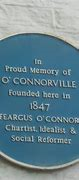
On May Day, so the 6th May 1849 edition of the Chartist newspaper the Northern Star reported, numbers of Chartists gathered at O’Connorville to mark its second anniversary.
O’Connorville was at Heronsgate in north-west London, a brisk walk from Chorleywood tube or a turning off the M25. It was part of the Chartist Land Scheme. This looked not to overthrow or even reform industrial capitalism but to opt out if it and return to the land and to farm small holdings on a series of Chartist settlements around England.
Chartists were chosen by ballot in a scheme that was popular enough for the Government to avoid over several years from agreeing it was legal. Most of those involved would have been only second generation industrial workers with a memory of rural life.
On that 1849 May Day at O’Connorville celebrations included a dinner, concert and a ball. The school room which was at the centre of the community was decorated with evergreens and large picture of the MP for Nottingham, the Chartist leader Feargus O’Connor.
It was reported that at 2pm 50 persons sat down to a ‘sumptuous dinner of ‘Old English fare’. Toasts at the dinner included one to ‘The People..may they soon be the source of all power’. Singing and dancing went on past midnight. The report concluded with the hope that the Land Scheme will lead to an ‘enlightened body of British Yeoman’, a reference to the Yeomanry who cut down protesters at Peterloo.
The same celebration was repeated in 1850, thereby qualifying as a tradition!
40 years before the start of the London May Day the tying together of politics and celebration focused on a desire to opt out of market capitalism. In 2026 it’s an idea that may have a renewed currency.


Leave a comment