
The British 1968: Hornsey College of Art Occupation 28th May
There is a school of right-wing history that sees Britain as exceptional. For example according to this view unlike other countries there was never a revolution that saw an industrial ruling class replace an old landed elite. There obviously has not been a 1917 style revolution here but that is far from the only model available. In fact we had the ‘Glorious’ Revolution of 1688.
So it was with 1968. All over Europe uprisings and revolts took place but apparently in Britain all was quiet.
This is far from the truth. The anti-Vietnam War demonstration at the US Embassy in Grosvenor Square in March set the template for such protests elsewhere. In the first weeks of May attention was focused on events in Paris and elsewhere in France.
The British 1968 started definitively later in May as students at the Hornsey College of Art in Crouch End North London occupied the main college building. There was a clear echo of French events because the students were focused on the conditions of their education.
The building itself has an interesting history, and some may know it better as the TUC’s National Education Centre. It is now a primary school.
The origins of the students grievances lay before 1968. The Labour Government was in the process of creating Polytechnics and the plan was to subsume the college into the new Middlesex Polytechnic. Already the college had elements of its activities scattered across north-east London.
The students felt that this would detract from their art education. They also complained that the facilities at the Hornsey building were poor, including recreation areas and toilets. In addition the college did not properly recognise a student’s union. Finally the students felt that the education they were getting was of a piecemeal fashion not adequately giving them the skills they required.
A student teach-in on May 28th 1968 led to a full occupation of the college by the students including control of the canteen which as health inspectors later agreed was run more safely than before. The occupation continued until 4th July 1968.
The college was run by Haringey Council which earlier in May 1968 had passed to Tory control for the first and probably last time. The Councillors were unsympathetic to Labour’s Polytechnic plans, and therefore had some joint ground with the students. But Tory Councillors could hardly be seen to backing student power.
As a result the Council did very little about the occupation for some weeks, while the Principal of the college was also absent.
There was extensive media coverage, although perhaps unsurprisingly given the context, there was more in the Daily Telegraph than the Guardian.
The students focused specifically on the issue of art education and mostly resisted attempts to more widely politicise the fight at Hornsey.
A Telegraph article on 2nd June 1968 was headed ‘Hornsey students issue reform manifesto. Clear off anarchists told’.
It was reported that the manifesto ‘demands the end of examinations based on academic studies. The imposition of a final examination in art history forced the subject into a rigid pattern’
Eventually the Principal conceded many of the students demand and an inquiry was set up under the auspices of the Institute of Education. The college re-opened in September 1968.
It might be argued, particularly at 56 years distance, that the limited nature of the students demands- refusing wider politicisation- hardly suggests that Britain was following the wider pattern of 1968 across Europe. Yet the reality was that the students were largely successful, in that perhaps they were exceptional.
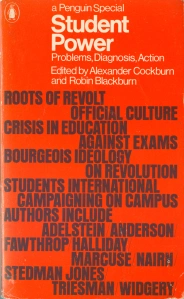
The wider issue raised, one perhaps almost forgotten 50 plus years on, is what this meant for ‘student power’. There was a Penguin Special of the same name (in association with New Left Review) and the theory was that students protesting at the increasing impact of the military-industrial complex (as it was then called) on their studies (see EP Thompson’s Warwick University Ltd) found it easier to revolt than workers. However that revolt, as in France in May 1968, could spark workers into fighting too.
One wonders in the age of tuition fees, cuts and austerity if the same might still hold. Current student protest camps on Gaza and Palestine at Universities in the US and UK make a direct link between the politics of 1968 and 2024


Leave a Reply