
Trade Union Membership in 2022: No Home But the Struggle?
The annual ONS report on trade union membership was published last week(it is quite lengthy & easily Googable) and should be of interest to trade union and socialist activists as well as historians.
The current series runs from 1995.
In 2022 union density dropped from 23.1% of the overall workforce 22.3% with overall numbers down by 200,000 to 6.25million.
While the drop is small and partly accounted for by an increase in the size of the total workforce, there has been a recent period of modest but sustained increases in total union membership so a fall is not good news.
It might be thought that with widespread strike action from summer 2022 around the cost of living and attacks on conditions, that membership would rise. While some leave when a union ballots for strike mostly a lot more join up. This has certainly been the case with the National Education Union based on its own reports.
However the ONS figures don’t break down into individual unions, and are confined to sectors which are broadly drawn and a source of frustration to both unions and employers who try to analyse the data!
One view might be that since many of the larger disputes are still in progress a conclusion, its too early to judge their impact on membership. Another might be that in many cases strikes which are unresolved cost people lost wages in a cost of living crisis.
Certainly if some of the outstanding disputes do end in victory for workers then that really should promote membership. That’s for the 2024 figures now.
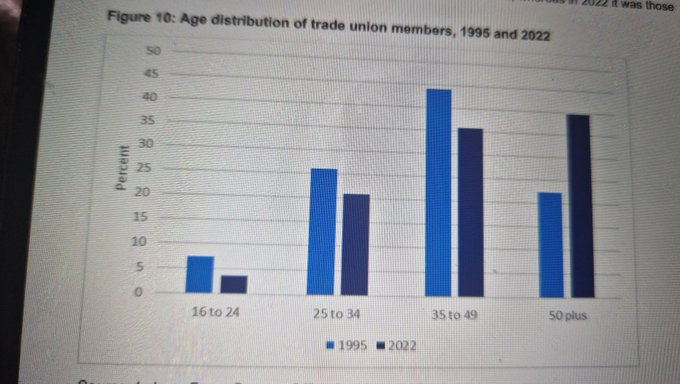
The report also highlights some perhaps known trends. Union membership amongst older workers is far higher than younger ones and that trend is increasing. Not enough young people join unions, even though it might be thought their working conditions would promote the thought.
The reasons are often complex. Take one. If you don’t plan a career in a particular job why join a union to make sure you can stay? If there are issues you can leave and get a job elsewhere. The ONS doesn’t have figures on how long people stay in jobs now but it would be interesting.
The ONS survey also underlines another well known point. Employers with over 50 staff are more likely to recognise unions and have collective agreements with them. Why? Because the alternative is a large and costly HR department.
Unfortunately that relationship does not always mean that union membership in those employers is particularly high.
As ever more questions than answers. Historically however there is a case for stating that the higher union density is in society the better things are in terms of equality and respect for people not just at work but generally. The Tories don’t agree with that. As for Labour, its very much work in progress.
The progress will come if some of the current large scale disputes end with a decent result which is seen as so by union members as well as union officials…


Leave a Reply