
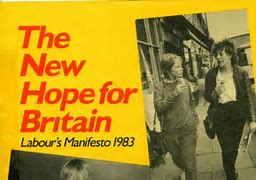
Labour’s 9th June 1983 Manifesto: 40 years before its time?
It is 40 years since Mrs Thatcher defeated Michael Foot’s Labour in the 1983 General Election.
According to a Radio 4 Archive Hour programme on the subject in 2013, the Labour Election campaign was shambolic and Foot, while appealing to some of Labour’s core vote, failed to connect to a wider audience.
Foot won 8.4 million votes achieving 27.6% of the poll which was certainly on the low side. Labour often tops 10 or 11 million votes in General Elections and on occasion higher. It is worth reflecting however that in 2010 Labour got 8.6 million votes and 29% of the poll.
The electoral point in 1983 was the break-away of the Social Democratic Party to the right of Labour which split the left of centre vote and allowed Mrs Thatcher to achieve a decisive victory and Parliamentary majority. It might be argued that the Falklands War helped although it could also be noted that the Labour leadership under Foot had supported the war.
It is argued that Foot, by 1983, a veteran Labour activist was not the man to lead Labour at a General Election.
Foot was a man of the left- a nuclear disarmer and an MP for a radical South Wales seat. Yet he was of the post-1945 left, not the new left that had appeared from the 1960s onwards. His victory in the Labour leadership election after the 1979 Labour defeat to Thatcher represented the culmination of decades of political work in the Party. But that was the past and Elections tend to be about the future.
It is an awkward reflection on modern politics that it is doubtful someone as old as Foot would lead a party into an Election now. It is a question of image, spin and discrimination that existed in the 1980s has grown worse since and needs to be tackled.
The reasons for Labour’s failure in 1983 have however been pinned on the Manifesto dubbed ‘the longest suicide note in history’. It is certainly long- manifestoes tend to be even now- but the notoriety relates to its political position.
It was a manifesto of the left, or one kind of left anyway. Its focus on managing the British economy and tackling high unemployment hardly seems that controversial now. Rather it was the attacks on it by Mrs Thatcher and those that had split to the SDP that framed it in this way.
Thatcher, who used to bang on about absurd comparisons between individual household borrowing and the national debt attacked the manifesto because it openly said that money would need to be borrowed to stimulate economic recovery. New Labour got around this charge of economic mismanagement in 1997 by saying it would stick to Tory economic limits, and much good did it eventually do them or the country’s economy.
The SDP meanwhile were upset by things such as the call for Britain to leave the Common Market. One doubts Nigel Farage has read the 1983 Labour Manifesto but it reminds that the demand to depart the EU has been as strong in parts of the left as it certainly is on the right.
Other bits of the Manifesto now seem to be amazingly good sense. For example it says the banks will need to be regulated to make sure they lend and invest. It also proposes to set up a Foreign Investment Unit to keep an eye on what multinational companies operating in the UK were up to.
Michael Foot may have been thought too old to lead the country by some, but these ideas were it seems 40 years before their time…


Leave a Reply