
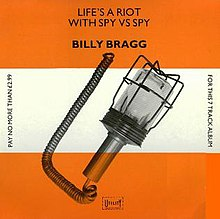
40 years of Billy Bragg
It is 40 years since Billy Bragg’s first record, Life’s a Riot With Spy v Spy was released on Go-Discs.
The Bard of Barking of course is still very much a feature of the music scene but he has also after 40 years found a place in social and labour history, albeit necessarily a provisional one.
Those who remember Bragg from that the early 1980s- I caught him carrying around his own amplifier at a union event in Battersea Park- will remember the impact he made in that post-punk, post-Falklands war period.
That first record includes one of his most well-known songs a New England where he sang ‘I’m not trying to change the world’. But after 40 years it might be argued that just a little bit he has.
His first national political engagement was with Red Wedge, a loose group of musicians including Paul Weller, the Communards and others, who played in support of a Labour victory in 1987. It didn’t happen but the idea of intertwining music and politics- dating in modern times from Rock Against Racism ten years earlier- is something Bragg above others has kept going.
His regular appearances at the end of the TUC’s Tolpuddle Festival in July each year are under written by the more sustained work behind Jail Guitar Doors, a title taken from the ‘b’ side of the Clash single Clash City Rockers, which is a project to give guitars and develop musical activity for prisoners and those released from prison. It runs both in the UK and the US
He has also, with the US band Wilco, done much to rescue some of the unrecorded music of Woody Guthrie releasing a series of Mermaid Avenue records and he has been a consistent presence in anti-fascist campaigns with another of his trade mark songs ‘All You Fascists Are Bound to Lose’
Bragg’s politics outside of music have proved more controversial, particularly his decision to support a tactical vote for the LibDems in his Dorset constituency in 2010. He has also campaigned around the House of Lords and proportional representation on an agenda of democratising British politics.
His record English, Half English about national identity sparked a debate on the left, again underlining the ability of Bragg’s music to inspire wider debate.
The generation that grew up with Billy Bragg in the 1980s were those who opposed Thatcher, supported the 1984/5 miners strike and demonstrated with CND. Many of them no doubt remain active in the labour movement, numbers as senior Labour MPs and union leaders.
In that sense Bragg’s music has provided the musical backdrop and, often the theme tunes, for the left’s activities over four decades
It is also worth reflecting that the political right have nothing similar, reflecting the cultural roots of the labour movement that the Tories simply don’t have. Perhaps that is because has Bragg himself underlines he doesn’t see himself particularly as political or protest singer but someone who writes songs about the realities of everyday life, some of which do, of necessity make political points.
If as the US singer Randy Newman often claims every musician who was on the road in 1973 is still on the road we’ll be enjoying Billy Bragg for many years to come yet. After all he didn’t really get going until ten years after that.


You’re far too kind to Bragg. He’s become a reactionary figure, railing for example against the largely Jewish socialists who made The Big Lie film about Corbyn.