
Could Peterloo happen again?
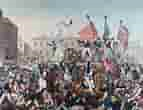
On Monday 16th August 1819 in central Manchester around 60,000 people gathered to protest for the vote which few if any of them had. Most of the men, or their descendants wouldn’t get the vote until 1918 and many of the women until 1928.
he Yeomanry, local businessmen on horseback, rode into the protesters, on the order of Tory Magistrate William Hulton and cut them down with sabres. Tens were killed and thousands injured.
The reason for the attack remains unclear. It may be that the Government had ordered it. It might be that the Magistrates acted on their own- they were certainly supported by the Government afterwards.The demonstration posed a new threat to the ruling order as the start of the age of mass democracy. The authorities were unsure how to deal with such a gathering with a shoestring if brutal police force- and feared violence.
Violence came from the authorities.
An issue is whether such an event could happen again.
The socialist historian E P Thompson argued that such was the reaction to Peterloo that the authorities determined not to violently attack peaceful democratic protest again.
Industrial disputes were another matter.
In fact during the Chartist period there were some attacks with deaths and injuries on protests, but nothing on the scale of Peterloo.
More recently however in Derry in 1972 at a protest for democracy, known as Bloody Sunday, the army did shoot and kill and injure protesters. Again the claim was the violence was planned.
50 years on with an increasingly authoritarian State could Peterloo happen again
Most protest in 2023 in Britain whether on climate or against racism or for better conditions at work relies on mass peaceful mobilisation. Civil disobedience is also a strategy used for example by Just Stop Oil but again peacefully.
Where violence does occur at protests it is often provoked by police tactics.
However if the State perceives a protest threatens the interests of capital the use of the army certainly can’t be ruled out. The 1984/5 miner’s strike gave a glimpse of that. It was an industrial dispute but also a political.
That said if demonstrations are large enough the capacity of the State to stop them in any way can be limited- see the 2003 protest against the Iraq War.
There is a wider perspective
Peterloo was about the demand to have the right to vote and participate in the Parliamentary process. One focus was on the price of bread, kept artificially high by the Corn Laws. They were repealed by Parliament in 1846/7 but successive Chartist demands for the vote through Parliamentary petitions got nowhere.
It was only in May 1867 when the Reform League gathered illegally in Hyde Park but the Government determined numbers were too great and too much was at stake to send the army- who were on stand by- in that progress on voting rights was made.
In 2023 a focus on Parliament remains. Despite many shortcomings and misgivings most want the Tories out and Labour in. Yet Keir Starmer is no keener on protest that Rishi Sunak and Suella Braverman.
Some argue that numerous recent changes to the law mean that protest has effectively been criminalised. Certainly as economic and political crisis hits Governments wants to dissuade protesters and not just in Britain.
The reality remains however that if the numbers mobilised are large enough the State does have to pay attention if not always give way. The lesson of Peterloo remains. Armed force creates as much of a crisis for the State as it does for our side
This post appeared in the Morning Star


[…] Could Peterloo happen again? […]