
The connection between smashing windows & the Stones Hackney Diamonds
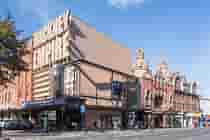
The Rolling Stones launched their first record of new songs for many years at the Hackney Empire on Wednesday. The Stones have no obvious connection with Hackney being a West London band with Dartford roots.
Hackney Diamonds is London slang for smashing windows and there is certainly a lot of history to that, a small part of it perhaps Hackney related.
I have researched the history of the modern riot [i.e since 1760] for several years and have published and spoken on some of my findings.
There remains much work to be done, in particular in examining how the riot, mostly held by historians to belong to pre and early industrial times, is still very much with us in 2023. It is a form of protest and social dislocation that does not appear to want to be consigned to the history books.
A sideline of the research led me to look at the issue of glass and windows.
Reading the Chartist paper the Northern Star for the year of revolutions, 1848 it is clear that one key determinant of whether a street protest or demonstration had any of the characteristics of a riot was whether or not any windows happened to be broken during the process.
The same criteria are used to determine the modern riot, although here arson plays a greater role in the assessment of whether a riot has taken place.
It would seem that glass and glaziers have an important if little remarked on role in riots. Indeed there is even a parable about the general question.
The role of glass in the development of capitalism cannot be overestimated.
The change to industrial production techniques and methods allowed for the mass production of glass and meant that things like the many thousands of glass panels that were a feature of the Crystal Palace in Hyde Park in 1851- in fact sixteen acres worth of glass- were possible.
Yet the production of glass remained a matter ultimately not for machinery but for skilled labour and there was a great shortage of it at the key glass factories of Robert Chance & brother William in Birmingham [Smethwick 1838] and Pilkingtons in the north-west. Indeed Chance recruited skilled workers from the rest of Europe.
In fact glass was possibly the ultimate nineteenth century hand based technology mass production industry and this was boosted very significantly by the removal of Excise Duty in 1845.
The conditions in the new glass factories were symbolic of Victorian capitalism- even if Chance did see himself as an employer in the Owenite mould. So much so in fact that Marx focused on glass production as evidence of the ‘one-sideness’ of labour in capitalist production, alienated from the products of its labour. Elsewhere in Capital Marx refers to a symbolic figure of the ‘glass-capitalist’. Perhaps not surprisingly Raphael Samuel in his survey of Victorian industry, the Workshop of the World notes that the glass industry was heavily unionised
The language of glass breaking is perhaps central to the early Victorian riot but we know rather little about it. We have no means of knowing for example who most of the rioters who smashed glass were, and why exactly they did. Nor do we know, as Isobel Armstrong notes in her book Victorian Glassworlds [2007] whether the worlds of glass breakers and glass makers ever overlapped. However the connection was and remains an intriguing one.
William Chance one of the two brothers who ran the Smethwick glass works referred to above twice helped to precipitate a virtual festival of major glass breaking.
In 1830 when Chance was High Bailiff of Birmingham he instigated a visit to the City of Duke of Wellington and Sir Robert Peel, as Armstrong notes both when then ‘at the height of their unpopularity’. She goes on to report that ‘the pair..were shipped up the canal to view the Chance works at Smethwick to the sounds of a hostile crowd’.
In the evening Chance held a banquet for the men in the centre of Birmingham, excluding those middle class elements in the City who backed reform. An angry crowd formed again, and glass was smashed.
In 1839 Chance by now a Magistrate tried to ban Chartist meeting at the Bull Ring [William Chance was an Anglican not a Quaker like his brother and so able to participate in official political life]on July 4th 1839. Chance turned to 60 Metropolitan police officers specially imported for the occasion from London. The result was two weeks of riots. These culminated on July 15 1839 when Armstrong recounts ‘from Moor Street to about a hundred yards beyond New Street there was scarcely a pane of glass left entire’.
Wellington it seems cared about windows. He had cared enough about the windows of the north front of Apsley House at the bottom of Hyde Park to have had them redesigned by Thomas Liddell in 1829. Yet his windows were broken three times in 1831 on 27 April in early October and again on 12 October.
Isobel Armstrong’s well researched and informative work on Victorian glass is the only modern work on the subject. While it contains a chapter about Chartism and riots it does not pursue the research agendas outlined in my opening lines here.
So, this is work in progress and comments are welcome


Leave a Reply