
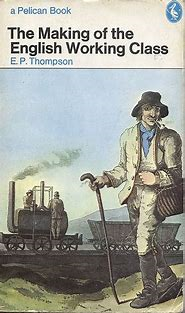
The origins of the cover of the 1968 edition of E P Thompson’s Making of the English Working Class
The 1963 hardback edition of E P Thompson’s Making of the English Working Class (Gollancz) featured on the cover, appropriately, an engraving related to Peterloo.
In a sense the events of 1819 were at the core of the book. Thompson saw them as setting the template for how both the nature of the working class movement and the State’s response to it developed.
The 1968 paperback edition which was the 1000th Pelican featured a detail from a print by R D Havell which had in the background a locomotive built by John Blenkinsop.The print itself is from a plate in George Walker’s 1814 book, Costumes of Yorkshire
George Forster of Leeds Library posted on the book and the specific image in 2012:
The most famous of Walker’s plates is no 3, “The Collier”, because it shows a man working at Middleton Colliery in south Leeds with John Blenkinsop’s recently invented steam engine in the background – the earliest known illustration of a steam locomotive on rails. The text reads:
“One of these workmen is here represented as returning from his labours in his usual costume. This dress is of white cloth bound with red, may probably be ridiculed as quite inconsistent with his sable occupation; but when the necessity of frequent washing is considered, surely none could have been adopted more conducive to cleanliness and health. The West Riding of Yorkshire, it is well known, abounds in coal, the consumption of which is prodigiously increased by the general use of steam engines. In the back ground of the annexed Plate is a delineation of the steam engine lately invented by Mr. Blenkinsop, agent at the colliery of Charles Brandling, esquire, near Leeds, which conveys above twenty waggons loaded with coals from the pits to Leeds. By two of these machines constantly employed by the labour of at least fourteen horses is saved.” [p 7]
http://theleedslibrarycollections.blogspot.com/2012/12/walkers-costume-of-yorkshire-1814.html
The point of course was that steam power and industry came together with the making of a working class. However as John Baxter has commented the figure of a miner was hardly centrally relevant to Thompson’s book:
The 1968 image(a contemporary print from book of Yorkshire costume) does signify advancing industrial change and a proto proletarian..in the form of the Yorkshire miner…however well this links to his heavy utilisation of West Riding activism..Thompson hardly mentioned the miners..something he acknowledged.Yes your alternative would have been appropriate.From research on the West Riding now completed and some in progress we see miners only on the margins of popular radicalism c 1792-1832.They do however get a better look in in work completed by Joe Stanley and myself.
The book remains in print and the cover has changed several times since. The 2013 edition of the paperback does have a cover featuring a Peterloo scene.
I’m still checking on whether Thompson had any input to the choice of the 1968 cover. Pelican had a distinctive cover design template but The Making seems a little outside of the mainstream in this respect


[…] Origins of the cover of 1968 edition of E P Thompson’s Making of the English Working Class […]