
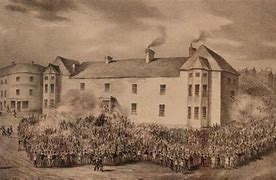
Newport 1839
An Insurrectionary tradition in the English Labour Movement?
In the opening seminar of the socialist history series at the Institute of Historical Research on 9th October Catherine Howe spoke on her important book London Story, 1848, on Chartism in the Year of Revolutions.
One issue touched on was whether in that year and before and after there was an insurrectionary tradition in the English Labour Movement.
It is true that there were moral force Chartists, who campaigned around issues like abstention from drink to hit Government taxes and provoke political change as well as personal change in the lifestyle of the abstainer. But these were a very small section of the Chartists who provided more than their fair share of chroniclers of the period.
Another Chartist tradition was that of exclusive dealing .Chartists refused to patronise shopkeepers who did not support the call for the vote. They often went further and occupied and shut the offending shops.
A third Chartist tradition was that of the armed rising. It is now accepted that events in early November 1839 in Newport where an attempt was made to spark revolution and numbers of Chartists were shot down by a crack British Army regiment were a very serious attempt to seize political power.
The distinction between moral and physical force Chartism is one largely created by historians of the Fabian mould who wanted to re-create the history of Chartism by emphasising its gradual and peaceful elements and minimising its more confrontational side.
Not many historians, by contrast, have argued that there was a specific armed tradition in the British working class. There is a case for this from Luddism to the attempts at armed revolution in 1817 to Cato St in 1820 and Captain Swing protests in the 1830s and the quite widespread arming of Chartists with pikes and sometimes guns.
Yet most historians have felt that to isolate an armed tradition is the wrong way to look at things.
A key Chartist slogan was ‘peaceably if we may, forcibly if we must’. In other words peaceful methods of achieving change were to be preferred. If they failed then force might be needed. Those who marched peacefully but on occasion wielded a pike were not different but often exactly the same people.
There have been violent incidents in English working class politics since, mostly relating to sabotage- as in the 1926 General Strike when a train was derailed, but the use of arms has not featured since the 1840s and the rise of organised labour and mass protest.
The much more common form has been what is often now called non-violent direct action which frequently involves protesters sitting down.
Historically and this remains a current issue the State has a near monopoly of violence and is liable to use it on occasion.
From time to time- for example the Bloody Sunday demonstrations in Trafalgar Square in 1887 police action has killed protesters. The Metropolitan Police website is still denying responsibility for that today by the way.
An obsession that only peaceful methods of protest should be used comes from much the same political stable as the idea that society can only ever be changed by Parliamentary action. Both have a considerable constituency but if they don’t work, people may try other things as they did in the 1840s.


Leave a Reply