
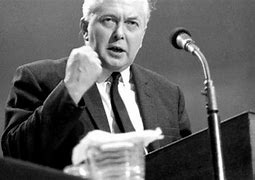
Labour Conference: Harold Wilson’s White Heat at 60
1963 was a year of change at the top of British politics.
Labour leader Hugh Gaitskell had died and been replaced by Harold Wilson, the left-wing candidate. By September, in the wake of the Profumo affair, Tory Prime Minister Harold Macmillan had resigned and been replaced by the aristocratic Alec Douglas Home.
A General Election was expected although it did not in fact take place until 1964.
Labour met in conference at Scarborough in the first week of October 1963 with Wilson set to make his first speech as Labour leader and lay out the Party’s position for the Election.
Labour had lost in 1951, 1955 and 1959 and some argued that the Party would never again achieve office. A document, Signposts for the Sixties, was before delegates. In the week of the conference the No.1 record in the charts was She Loves You Yeah Yeah by an up and coming group from Liverpool, the Beatles.
Recordings of the speech are very hard to come by, but on the 50th anniversary, 1st October 2013, the Peoples History Museum used the actor Colin Smith to read it in character as Harold Wilson, with commentary by the historian Steve Fielding.
Some of the speech, now 60 years on, now seems very dated. Wilson, for example, was clearly unpersuaded by the need for colour television.
His general drift however was one that has distinctly modern echoes.
He argued that at the top of British industry was to be found aristocratic wealth and speculative finance but that the world was changing. The old boy network which could always rely on a special relationship to get it out of trouble was becoming outdated.
Wilson focused on the themes of science, socialism and planning.
He argued that automation and an end to the arms race leading to disarmament would lead to massive job losses and this must be addressed by creating new jobs.
Wilson was both too pessimistic and too optimistic here. The arms race did not end. While automation and new technology certainly did appear, and jobs were hit, it was on nothing like the scale in many areas that Wilson thought.
The Labour leader underlined that the Party must embrace progress- ‘ no room for Luddites in the socialist party’ he argued but also Britain must provide far more educational opportunities through new Universities- Labour created the Polytechnics-and through State investment in the utilisation of the skills of chemical engineers.
While the speech was Wilson’s apparently written the night before, many of the ideas that inspired it came from a young Labour MP, newly returned to Parliament in August 1963. His name was Tony Benn and he was employed at that time as Wilson’s speech writer and media man. By 1966 Benn had become the first Minister of Technology.
The ideas behind the speech although they sound radical 60 years on were problematic for the left. Firstly because Wilson attacked ‘restrictive practices’ on both sides of industry, heralding the battles over productivity to come with the trade unions.
Secondly because as New Left Review noted at the time for Wilson the problem of British industry was essentially one of the need for more efficient managership. For socialists by contrast it was about who controlled the levers of production- ordinary people or the wealthy.
Wilson’s speech positioned Labour as the party of progress and modernisation, a point not lost on Tony Blair when he created New Labour and one that is arguably echoed faintly and much less eloquently by Keir Starmer.
Wilson’s two Governments covering the years 1964-70 achieved a good deal in some areas but perhaps not so much in the areas covered by his 1963 conference speech


Leave a Reply