
London Socialist Historians Group
12th October
Historians congratulate Michael Rosen on 2023 PEN Pinter Award: An Historian of the Present
The London Socialist Historians Group, which organises the socialist history seminar at the Institute of Historical Research, has congratulated author Michael Rosen on being the recipient the 2023 PEN Pinter Award.
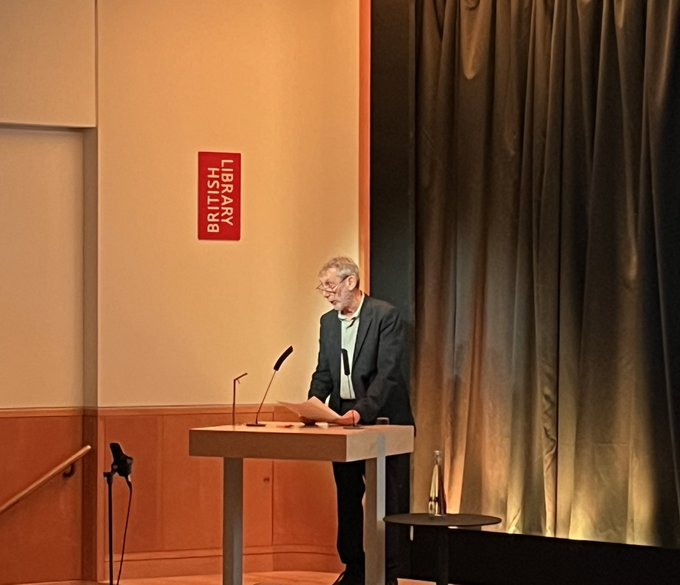
Rosen spoke to the Award at the British Library on 11th October and in doing so named Uyghur writer Prof Rahile Dawut as the Writer of Courage. She has been imprisoned in China since 2017 for her writing on Uyghur folklore.
The historians say that in his writings on the history of his family in the Second World War and after and linking them with the issue of refugees and dispossessed in the present day Rosen has underlined his importance as an historian of the present. No doubt the writing is not entirely welcome to those in authority who continue to fail to provide legal and safe routes for refugees to Britain, but it is all the more relevant for that.
Writing in 2022 London Socialist Historians Convenor Dr Keith Flett noted
Michael Rosen is known as an author and broadcaster, a socialist and anti-racist and come to that a beard wearer and Arsenal fan.
He is not known as a research historian but that doesn’t mean he can’t be one. After all the great socialist historian E P Thompson started out teaching English literature and only stumbled into history as a byway initially.
The Missing is a brief volume of short chapters and some poems.
It does have references and an index at the end but it lacks the kind of academic apparatus that we look for in research history. Where for example are the footnotes??
Partly the answer is that the Missing is a book aimed primarily at young people, aiming to get across in deeply personal terms what the Holocaust actually meant.
But partly it doesn’t matter. Rosen has spent decades researching his family history and the research methods cannot be faulted.
Of course in the 2020s the internet can be helpful but can’t be relied on as a definitive source. Rosen doesn’t do that. He seeks out obscure books that mention his family and contacts libraries in France to see if they have any records.
What he finds doesn’t make for particularly happy reading but it is important, vital, even reading for our times.
He notes:
With every passing year, the number of Holocaust survivors gets smaller. We need to keep them the memory of them alive: the people who died and those who survived. That’s partly why I wrote this book.
The other reason, Rosen notes, is because the wider message of The Missing is about refugees and that is still with us, although those in political power in the UK at the moment would clearly prefer that it wasn’t.
That means the book is not only fascinating and important history but it has relevance now, as the best history should have.
And the awkward questions raised? Surely why there is not more research on this that gets out of the seminar room and into the public domain, because it needs to be read, understood, discussed and in times like these acted on.


Leave a Reply