
Labour Election victories October 1964 & 1974: A Change Is Gonna Come?
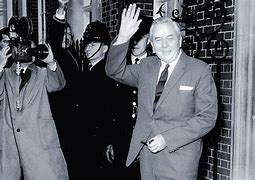
It is the anniversary of the Labour Election on 15th October 1964 and also the anniversary of the victory on 10th October 1974. In both cases Harold Wilson became Labour Prime Minister.
Both Election victories and the context they took place in are fast moving from living memory into labour history.
In both cases the Labour majority was slim-an overall majority in single figures in both 1964 and in October 1974. Indeed so small was the margin in 1974 that Labour spent some of the time up to the 1979 Election in a Lib-Lab Pact which itself may seem rather odd to those more familiar with the events from 2010-15.
In 1964 Labour was expected to win well.
After their 1959 Election victory the Tories had suffered a number of crisis not least the Profumo sex scandal that in effect saw Tory Premier Macmillan bow out of politics. His replacement, Alec Douglas Home, an old Etonian who looked and sounded as if he was from a by-gone age, and very probably was, was widely satirised.
Labour stood on the need to ‘modernise’ Britain and move firmly into the 1960s based on scientific and technological advance. Part of that was aimed at restrictive practices in industry but there was also criticism of trade union protections.
That is worth remembering as in recent times there has been a trend to see ‘Old Labour’ as fundamentally different from what came afterwards.
The narrowness of the Election victory was a surprise, not least to some of the left.
New Left Review urged Wilson to push on with change as the only way to keep Labour in Office. Whether that was his record can be debated by historians- left activists from that period would certainly say not I think- but in 1966, when an early Election was called Labour was returned with a 100 seat majority.
NLR also pondered why Labour’s margin of victory in 1964 was so small. It reflected that a mood for change which was to be found in the media and in public discourse was not yet fully in tune with the feelings at the grassroots of society.
Indeed as David Renton’s review of Ford and Goodwin on UKIP reminds us historically sections of the working class voted Tory and did not automatically and sometimes at all support Labour. In 1964 seats in cities like Sunderland and Liverpool were won by the Tories.
This was after all the period of the long post-1945 boom and whatever the specific economic problems of the moment, many in work were feeling better off. The crisis was more one of politics and the future of Britain rather than the economy.
October 1974 was very different. Britain faced an energy crisis and Labour had been returned to Office in February 1974 on the back of a miners strike. Tory Premier Heath had called a ‘Who Governs Britain’ Election and the voters had determined it wasn’t him.
It was a period of significant class struggle in the UK which was at best only partially reflected within the Labour Party itself. Moreover 1974 was also the year of the Portugese Revolution and much of the left was taken up, quite rightly, with events in that country.
Tony Benn’s Diary records the October 1974 Election as one where ‘red scare’ tactics were used against the left. Harold Wilson on the advice of the Security Services determined not to appoint the left-winger Judith Hart as a Minister because she had Communist connections. She did indeed. She had telephoned a meeting organiser to say she could not speak at a meeting because a Communist was on the platform. Wilson backed down.
Perhaps the wider historical point to ponder here is that while Labour was in Office for 11 of the 15 years from 1964 to 1979 and again for 13 years from 1997 to 2010, and while some changes for the better were made, the chance to re-shape the system in the way that Thatcher did, let alone to bring about any fundamental change was passed by.
In that sense the New Left Review comment of November 1964 that Labour needed to push on with change to secure support was both correct and over optimistic in thinking it would.
It all seems a long time ago now but there is context for Starmerism here.


Leave a Reply