
Measuring the size of demonstrations
Ahead of Saturday’s London demonstration (assemble Park Lane) calling for a genuine ceasefire in Gaza and support for Palestinians the Met Police have issued some thoughts. Some are about what,in their view, might be unlawful chants or placards. With over 1,000 Met officers suspended for a range of disciplinary reasons its difficult to think of an organisation less well qualified to pronounce on this. It is in fact the job of the CPS and the Courts not the Met.
They have also said they expect 100,000 to attend. This figure is likely to be quoted in media coverage after the demonstration
The London demonstration for a ceasefire in Gaza on 11th November was according to a police estimate, 300,000 strong. It was of course much larger. Some of those involved were also organisers for Stop the War demonstrations twenty years ago on Iraq. That included the largest ever in UK history when well over a million marched to Hyde Park. A figure of 800,000 has been mentioned and certainly it took hours for marchers to make their way down Park Lane to Victoria and Vauxhall Bridge Rd and eventually Nine Elms. Given the length of time it took for marchers to move from Hyde Park to Nine Elms- four to five hours in many cases-it may well have been larger.
It was and is difficult to argue about the size of the 2003 march as there are pictures of a huge crowd in the Park. When protests end elsewhere in central London it’s much more difficult to assess numbers. There were two stages on Saturday 11th November(after police eventually agreed at 8.30pm on the Friday evening) which made it particularly difficult,but also suggests that the police knew the march would be huge.
The State has had varying perspectives on assessing numbers on protests. Historians are still debating how many were at Peterloo in 1819 but the authorities were not counting. Their view was simply that it was too many.
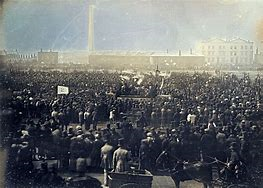
The Chartist protest on Kennington Common on Monday 10th April 1848,the first to be photographed, saw a new and now familiar strategy deployed. Again historical debate about numbers continues. The papers suggested tens of thousands- the official view- while many Chartists reckoned around 100,000. The Chartist leader O’Connor suggested far larger numbers, an unhelpful perspective which still sometimes happens.
The Anti-Vietnam War protest in central London on 27th October 1968 had around 100,000 on it. The BBC reported 25,000 which was possibly a police figure. If it was the question was raised why 6,000 police officers were needed. 2,000 were deployed this Saturday.
In recent decades the Met Police have generally stopped estimating protest numbers. It’s not their job- knowing a rough size of course is, for crowd safety purposes only. On very large protests it’s hard to be sure of precise numbers. People leave and join on route and at the end before a rally starts.
Recently the police seem to have started estimating numbers again. There method of counting historically has been to assess how many marchers pass a particular point over a set period of time and then extrapolate. It is one way of doing it but as above it ignore the complexity of huge marches. Some sections are tightly packed, some not and so on
The purpose of reporting on numbers again is political of course and was a subset of the Suella Braverman Culture War department. The reality is that on Saturday 11th November Braverman lost this particular Culture War but the numbers game is continuing
The outrage that is Gaza will provoke further and possibly even bigger yet protests.


Leave a Reply