
London Socialist Historians
30th November
Sheila Rowbotham on E P Thompson’s Making of the English Working Class at 60
Sheila Rowbotham has written about her relationship with Dorothy and Edward Thompson in her memoirs. It covered an extended period from when Edward was writing the Making in the early 1960s to Rowbotham’s own ground breaking socialist feminist histories from the late 1960s onwards.
On Radio 3 at 22.45 on Monday 4th December Rowbotham discussed the continuing influence of the Making sixty years on.
She recalled the times she met the Thompson’s in Halifax and her familarity with many of the locations in the book, growing up in Yorkshire. She was critical of the absence of women in the Making noting that in the 1950s and early 60s Thompson’s sources were mainly of male activists. She also reflected on the lack of a focus on slavery. She concluded though that while the book at sixty may be outdated in some ways, the approach Thompson took, of history from below with a focus on the activity of ordinary people was still an influential one.
Rowbotham’s commentary can be heard on BBC Sounds at the link below. There are four more programmes this week looking at issues such as what Thompson learnt as an adult education tutor, the absence of slavery in the book, and the impact of Thompson’s break from the Communist Party.
https://www.bbc.co.uk/sounds/play/m001svv9
https://www.bbc.co.uk/sounds/play/live:bbc_radio_three
The Radio 3 summary of the programme is here:
On reading The Making of the English Working Class
The Enormous Condescension of Posterity
Sixty years after it was first published, five essayists reflect on the legacy, ideas and personal inspiration of The Making of the English Working Class – and plot its place in the present day.
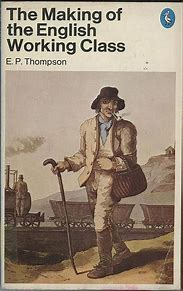
EP Thompson’s landmark social history, The Making of the English Working Class, is a book that changed lives. In an academic world where history was primarily concerned with power and political reform, EP Thompson sought to rescue working people from, as he put it, “the enormous condescension of posterity”.
It’s a book that lies at the root of contemporary social history, of cultural studies, sociology and anthropology, where, in the years after its publication, the idea of agency – the ‘making’ of the title – came to be a defining touchstone in thinking about culture and society. And it was popular too, even if its easily recognisable blue Pelican covers – and almost 1,000 pages – were possibly more dipped into than read cover to cover.
The writer and historian Sheila Rowbotham first met Edward and Dorothy Thompson in 1962, a year before the publication of The Making of the English Working Class. In this essay, she remembers their catalytic influence on her own life and work – and the continuing relevance of the book she first read in proof form as a student.
Sheila Rowbotham is a historian of feminism and radical social movements. She has published memoirs of her life in the 1970s and 1980s.


Leave a Reply