
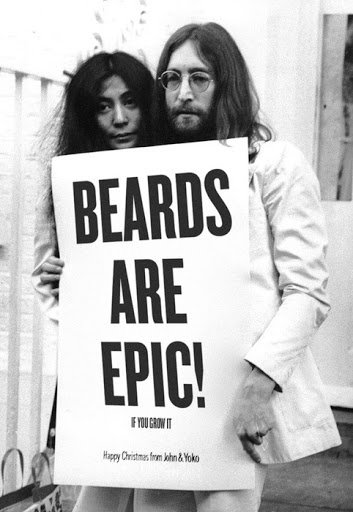
John Lennon 9 Oct 1940-8 Dec 1980. From Can’t Buy Me Love to Revolution.
John Lennon was shot and killed 45 years ago on 8th December 1980, aged 40.
In the days long before 24 hour news, social media, the interwebs and mobiles news travelled more slowly. I recall hearing of Lennon’s death at a trade union committee meeting in New Barnet. I was 24 and even that age slightly too young to have been around for the Beatles peak period in the sense of buying their records, at least until the late 1960s.
45 years after his death Lennon has passed into history himself now (20 years being one benchmark between history and the present broadly speaking). How he will be remembered by those who do remember him and those who don’t is an interesting question. The Lennon of Cant Buy Me Love or the Lennon of Revolution? Or both perhaps…
The Beatles released the John Lennon song Revolution on 26th August 1968 and sat at No.1 in the charts for 12 weeks.
Revolution was the ‘b’ side to a rather better-known Beatles song, Hey Jude. If that song has primarily endured as something that audiences at major events worry Paul McCartney may pop up and try to sing, Lennon’s thoughts on revolutionary politics remain of interest.
The chronicler of Beatles songs, the late Ian McDonald, noted that the musical range that spanned Lennon’s earlier song, I Am the Walrus, and Revolution was unmatched by any post-1945 musician.
The song was rejected as an ‘A’ side officially because it was too slow but really because McCartney, at that time, regarded it as politically controversial. The singer later changed his position and released Give Ireland Back to the Irish, as a single which was promptly banned by the BBC. Revolution never was.
Revolution was recorded in May 1968 as the Paris ‘nights of the barricades’ reached their peak. However alternative and longer versions of Revolution appeared on the Beatles White Album.
But it was not the music of Revolution, essentially a slow blues, that caused comment and controversy but the words.
In particular debate centred around Lennon’s words that ‘when you talk about destruction’ you can ‘count me out’ which on an alternative version he sang as ‘count me in’.
Those used to British TV in 2025 may be slightly amazed that a video of the Beatles performing Revolution was aired on the BBC’s Top of the Pops in September 1968.
Lennon’s drift in the song was that change in society had to come through ‘peace and love’ rather than a more combative approach to capitalism.
It was not well received by the left, which considering the furore it caused on the right was unfortunate for Lennon.
Lennon was clearly alive to the Beatles main audience in 1968, a worldwide one of youth who were rapidly becoming radicalised.
The Rolling Stones had very much the same idea with Street Fighting Man, a song which now sounds distinctly odd when sung by Sir Michael Jagger, if it is.
Lennon’s track provoked an article in Time magazine and a critical response in song from Nina Simone that deserves to be better known particularly in the age of Black Lives Matter.
The British radical paper Black Dwarf attacked the peaceful sentiments of Revolution, provoking an exchange on revolutionary politics between Lennon and the paper’s Editors. In the US the new left saw it as a ‘betrayal’ of the movement and a ‘petty bourgeois cry of fear’.
Ian MacDonald nevertheless argued that the song was the first ‘crack in the Beatles corporate façade’, while, no leftist himself, going on to note that by 1987 Revolution was being used by a Nike in an advert to promote its training shoes.
Historical hindsight tells us that Lennon himself was a on a political journey, reflected in the words of the song and his indecision about whether he supported the ‘peace and love’ pacificism of the 1967/8 period or the harder revolutionary politics that began to appear as the 1960s drew to a close.
By 1970 the Beatles had split up and Lennon was in the US, often seen as a participant on left-wing demonstrations and reportedly funding left-wing campaigns. Certainly by that time the man who had sung Can’t Buy Me Love less than 10 years before was regarded by the FBI as a political subversive whose activities needed to be watched

 Kmflett's Blog
Leave a comment