
‘Hen Chartists’ and ‘Vulgar Viragos’: Rethinking the role of women in the Chartist Movement Judy Cox Date: Monday 5th February
Report
Judy Cox underlined the difficulities of uncovering the activity of Chartist movement, who were a key part of the movement. She noted that letters, diaries and biographies were not the place to look but rather the press- the Times and in particular the Chartist press.
She drew links between the traditions of Chartism women, often organised and militant, and later women’s suffrage activities and a wider range of radical causes.
She also noted that while some Chartist men played down the role of women in fact the National Charter Association, the world’s first working class party, founded in Manchester in 1840, admitted women as equal members.
A recording of the seminar is at this link
Judy Cox has previously addressed the subject as part of a wider discussion
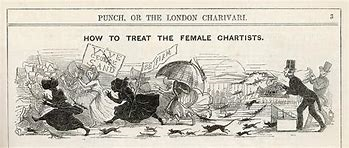
By 1838 the campaign for democracy developed into the Chartist campaign for universal male suffrage: “Chartism was the first instance of a political movement initiated and sustained by working people relying on their own resources alone”. [6] Thousands of women were active in the Chartist movement. They organised over 100 separate female Chartist associations between 1838 and 1849, some of which had thousands of members. [7] Women signed the “monster petitions” presented to parliament, they wrote articles, went to and spoke at public meetings and took part in strikes and riots. One witness described what happened during the Newport Uprising of 1838 when Chartist Henry Vincent was arrested:
Some of the women who had joined the crowd kept instigating the men to attack the hotel – one old virago vowing that she would fight till she was knee-deep in blood, sooner than the Cockneys should take their prisoners out of town. She, with others of her sex, gathered large heaps of stones which they subsequently used in defacing and injuring the building which contained the prisoners. [8]
Women were again prominent during the strike wave of 1842, which become known as the Plug Plot Riots.
Some influential feminist historians have argued that the Chartist movement had a detrimental effect on campaigns for women’s rights. The male leaders, “enforced female domesticity”, promoted “patriarchal power”, “disempowered women” and put them off joining any subsequent campaigns. [9] Yet female Chartists challenged ideas about women’s domestic role by becoming activists, organisers and, occasionally, leaders. Susanna Inge and Mary Ann Walker established the Female Chartist Association in 1842 and both lectured to mixed audiences. Anne Knight criticised those who claimed that the class struggle took precedence over women’s rights. She demanded that the Chartist movement campaign for true universal suffrage and a minority of male Chartists such as William Lovatt and R.J. Richardson agreed. Knight presented a petition demanding women’s suffrage to the Lords in 1852. The female Chartists established a tradition of female political activism in areas such as West Yorkshire and East London, which erupted into an intense campaign for female suffrage in the following decades.
International Socialism Spring 2018


Leave a Reply