
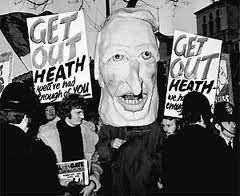
50 years ago this month. Miners strikes, three day weeks & a General Election
50 years ago, Christmas 1973, a Tory Minister John Davies wished his family a happy Christmas and urged them to enjoy it as it might be their last.
This remark has gone down in history and is generally held to mean that Davies felt that capitalism in Britain was about to collapse.
It is possible that this was at least one aspect of Davies’s meaning. However looking at a summary of what Davies later told the late Guardian journalist Hugo Young at a Chatham House rules event at the Institute of Historical Research in London, it seems clear that the dominant thing in Davies mind was something perhaps related but also a little different- and more relevant to us 50 years on.
A miners overtime ban had started on 12th November 1973 and was to end in February 1974 with the ejection of Heath’s Tory Government and its replacement by a minority Labour administration. Heath had called the Election on the question of whether he or the trade unions governed the country. The electorate responded by ejecting the Tories from Office
A three day week in industry and rolling power cuts had been started by Heath from the 31st December 1973. 885,000 workers signed on as unemployed for two days a week. The three day week and power cuts did not end until early March 1974
The Tories blamed the impact of the miners overtime ban but even evidence available at the time suggested this was unlikely to be true. The miners action had its effect but in reality coal was still reaching power stations and oil fired stations were unaffected.
As we know with the benefit of hindsight the Tories were already developing an obsession with the miners that was to lead the 1984/5 strike.
Davies however had a wider concern and this was the crisis in oil supplies and the huge increase in their cost. The price hike was sufficient to provoke an economic crisis, which led to the subsequent Labour Government taking a loan from the IMF in 1976 and ushering in the era of cuts in public spending that we have been in ever since.
The oil crisis had been immediately sparked by the war between Israel and Egypt. Egypt lost and one result was that oil supplies were reduced and prices increased by Arab oil countries.
The post-1945 era of cheap energy was over as was the economic boom based on it. Without question John Davies grasped this as did, based on his Diaries at the time, Tony Benn who was a Shadow Minister responsible.
The entries in Benn’s Diary for December 1973 and early 1974 are well worth reviewing. There was a palpable and mounting sense of crisis with a real feeling that the capitalist system itself was in question.
The miners action framed this and the three day week underlined it but it was the energy crisis and its economic impact that was the longer term issue. It is one that remains with us 50 years on.
It is not a version of contemporary history that you are likely to easily stumble across. The current populist TV historian of the moment Dominic Sandbrook won’t suggest that one lesson of the study of recent history is that the foundations of modern capitalism are built on sand.
Moreover there is now at least one generation active on the left that is probably for the most part unaware that within living memory a group of workers, the miners, could challenge the Government and, in effect, bring it down.


Leave a Reply