
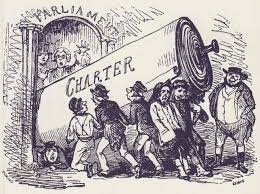
My thanks to my trade union colleague John Ferrett for alerting me to the point that Liz Truss managed a reference to the Chartists in her speech to the hard right CPAC Conference near Washington a few days ago. I can find no text version of her speech but she has posted a clip which contains the Chartist reference on Twitter.
Its likely that the far from huge crowd listening to Truss were baffled by her reference where she noted that movements of popular democracy such as the Founding Fathers (US) and the Chartists represented the will of the people against vested interests (of whom she has an ever increasing list)
Indeed if a Sunday Times report of the conference (25th February) is correct the audience had no idea who she was beyond ‘that British lady’
Truss studied PPE at Oxford where its possible the Chartists got a mention, although she is just as likely to have picked it up from her parents who were somewhere on the left.
It has been pointed out that Chartists activists and leaders suffered persecution and prosecution in their fight for democratic rights including jail sentences and deportation. While some might feel Truss should stand trial for various things that happened in her 49 days as PM in reality she remains at large and- hence the conference appearance-has a book coming out
The reference to vested interests has some potentially awkward connotations since the far right sometimes use it to refer to Jewish capitalists. Its of course unclear if this was in Truss’s mind.
In the nineteenth century as E P Thompson points out in the Making of the English Working Class it was a term used by William Cobbett to attack the Old Corruption of the pre-1832 political system. Cobbett focused on particular groups (rather like Truss’s Woke list) rather than develop a theory focused on overarching political or economic power
The Chartists by contrast focused initially from 1838 on political power, the Six Points of the Charter, the right for men to vote, secret ballot, equal electoral districts and so on. After 1848 they added the Charter and Something More a focus on economic and political power.
The point is that the Chartists were a genuinely popular movement, able to mobilise thousands in a range of tactics and strategies. Truss by contrast has no obvious popular base. The Chartists worked from below, rather she works from above, if it came to it, the politics of a coup d’etat rather than a social revolution


Leave a Reply