
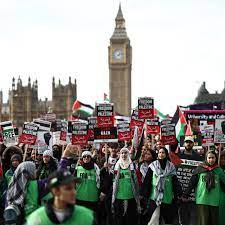
If protests didn’t work they wouldn’t try to ban them
The Times which frequently runs Editorials on protests (in the UK a bad thing, elsewhere often to be applauded) has determined (29th Feb) that banning demonstrations on Palestine would be wrong. It suggests instead that protesters just stop having them.
The right to demonstrate was hard won in practice. It took a massacre at Peterloo in Manchester on 16th August 1819, where soldiers on horse-back, cut down and killed and injured protesters for the vote, to remind that State that allowing political demonstrations was perhaps, mostly, preferable to such confrontations.
It is a right that has needed to be exercised in practice down the decades and centuries, and there have of course been times when demonstrations were banned, or attacked by the police.
Since the 1960s protest marches have become a significant way of focusing on issues which official Westminster politics ignores.
CND set the benchmark from the late 1950s often bringing hundreds of thousands on to the streets in an effort to ban nuclear weapons. They did so again on cruise missiles in the 1980s. It reinforced and promoted a tradition that democratic politics was about people themselves being active, as much or sometimes more than, voting for an MP every few years.
27th October marked the 55th anniversary of the anti-Vietnam War march that went to Hyde Park with a small breakaway to the US Embassy in Grosvenor Square, central London*. 1968 was a year of revolt and the State took precautions against revolution.
Protesters may have had this in mind in some cases, but the immediate aim was to stop war. That demonstration of 100,000 was historically large but much larger protests followed. The march against the Iraq War on 15th February 2003, which saw well over a million on the streets remains the largest so far in UK history.
That march ushered in an era when the message that politics was as much for the streets as it was the Commons reached a much wider layer of people. The right, with the Countryside Alliance, and the centre, with pro-EU marches also put hundreds of thousands marching through London.
These were usually one off marches, not within a democratic structure and certainly not feeding into longer running campaigns like CND and Stop the War. The distinction is important. It’s not just the march but the on-going grassroots, community and workplace organisation that is key.
In the last period a Conservative Government has sought increasingly to crack down on the right to protest. The last Home Secretary Suella Braverman gave a strong impression of wanting to ban all protest. Labour leader Keir Starmer, despite a human rights lawyer background, often seems not far behind. He has clearly read at least the opening passages of Ralph Miliband’s 1961 book Parliamentary Socialism which notes that Labour is the most dogmatic of parties- about Parliament not socialism.
Numbers on the streets can frustrate the banners. Current protests in support of Palestine have seen hundreds of thousands participate. Starmer has attempted to ban Labour from having anything to do with them. As Aditya Chakrabortty has argued in the Guardian the freezing out of legitimate issues from official politics simply encourages people to protest more.
There are two wider points. Firstly marching is not the only way to get change. There is indeed what the US sociologist Charles Tilly called a repertoire of contention, of possible strategies, from riots to meetings, petitions and lobbies. All have their place depending on context.
Secondly that the era of mass politics will continue, as politics is defined by the media and politicians as something that is done from above, the motivation to effect change from below grows with it. Its surely what motivated those who made their way to Manchester on that August Monday in 1819, and history suggests that it can work
Ian Birchall writes
The main 100,000 demo went to Hyde Park, not to Grosvenor Square, where it was feared there would be a police ambush and mass arrests. A small Maoist breakaway went to Grosvenor Square; the press, anxious to foment divisions, gave it a lot of attention. (I think Mick Jagger was also there).
An earlier version of this post appeared in the Morning Star


Leave a Reply